ResourcesThe Modern Commercial Landlord
The Modern Commercial Landlord: Why Property Management Needs a New Operating System
CRE operations have changed. Why the accounting system isn't the problem, and what a connected operating layer for commercial landlords looks like.
Vestibule Editorial
· 8 min read
Running a commercial property today looks very different from how it did fifteen years ago. Tenants expect to pay electronically, get answers quickly, and find information without chasing anyone down. Owners want a clear picture of their portfolio without waiting for the month-end package. Lease documents are longer, amendments pile up, and the people managing them are stretched across more buildings.
The work changed. For many commercial property teams, the tools that support the daily operation haven’t changed much at all.
It’s still common to see a landlord with a capable accounting system surrounded by a patchwork of everything else: lease terms in PDFs, critical dates in a spreadsheet, rent arriving by check, maintenance requests in someone’s inbox, and tenant questions answered by whoever happens to pick up the phone.
This article explains what’s changed, why the accounting system isn’t the problem, and what a modern operating setup for a commercial landlord actually looks like.
What changed
Four shifts make a different way of operating possible. None of them is new on its own, but together they change what a commercial landlord can reasonably expect from their tools.
1. Business payments moved to electronic rails. ACH volume keeps growing, and business-to-business payments are a big part of that growth. Nacha reported that the ACH Network handled 35.2 billion payments in 2025, with B2B payments up almost 10% to about 8.1 billion (Nacha, January 2026). These are network-wide figures for all kinds of business payments, not a measure of commercial rent. But they show where business payments are heading, and many commercial tenants already pay their other vendors this way.
2. Checks became a bigger risk. In the Association for Financial Professionals’ 2025 survey, 63% of organizations reported attempted or actual check fraud in 2024, making checks the payment method most often targeted (AFP, April 2025). For a landlord collecting large monthly rent payments, that’s a real exposure.
3. Documents became readable by software. AI-assisted document processing can now pull key terms out of a lease, such as rent schedules, escalations, renewal options, and critical dates, and turn them into structured data. It isn’t perfect, and a person should still check the output against the lease. But it can reduce the manual work of finding and re-typing terms, so more of the team’s time goes into verifying the results instead of extracting them.
4. Tenant expectations caught up with the rest of their business. Commercial tenants run their own companies on cloud software. They’re used to logging in, seeing status, and getting answers without a phone call. When their landlord’s process runs on checks and email, they notice the difference.
The accounting system isn’t the problem
It’s tempting to frame this as “old software versus new software.” That’s the wrong framing.
Platforms like Yardi, MRI, and AppFolio are built to do something important: keep an accurate, auditable record of a property’s finances. General ledger, receivables, payables, owner reporting, and financial controls belong in a system designed for that job. Most commercial landlords should keep using the one they have.
The problem is everything that happens around the accounting system. Daily operations, like a tenant asking a question, a payment arriving, a lease amendment getting signed, or a work order getting opened, often happen in email, PDFs, spreadsheets, and phone calls. Someone then has to re-key the result into the system of record.
That’s where time gets lost, errors creep in, and tenants experience the landlord as slow or hard to reach.
The better model is simple:
Your accounting system stays your system of record. Your daily operations get a connected layer that works with it.
That way, no one has to rip out a system the accounting team relies on, and the people running the buildings get tools built for the work they actually do.
At a glance
Daily work runs in a connected layer; accounting stays the system of record
work in
Connected operating layer
stays in sync
Accounting system of record
Yardi, MRI, AppFolio, or similar: general ledger, receivables, owner reporting
Tenants and property teams work in the connected layer every day. The accounting system underneath stays the financial record, and the two stay in sync.
What the operating layer includes
A modern operating layer for a commercial landlord covers the work that happens between the lease and the ledger. In most portfolios, that means five areas:
| Area | What it replaces | What good looks like |
|---|---|---|
| Lease data | PDFs and a critical-dates spreadsheet | Key terms, escalations, options, and dates pulled into structured data and reviewed by a person |
| Rent collection | Paper checks and manual deposits | Tenants pay by ACH or card, payments are matched to charges, and exceptions are flagged |
| Tenant communication | Personal inboxes and phone calls | One place for tenant questions, notices, and history, visible to the whole team |
| Service requests | Emails to the building engineer | Work orders submitted, tracked, and closed out with status the tenant can see |
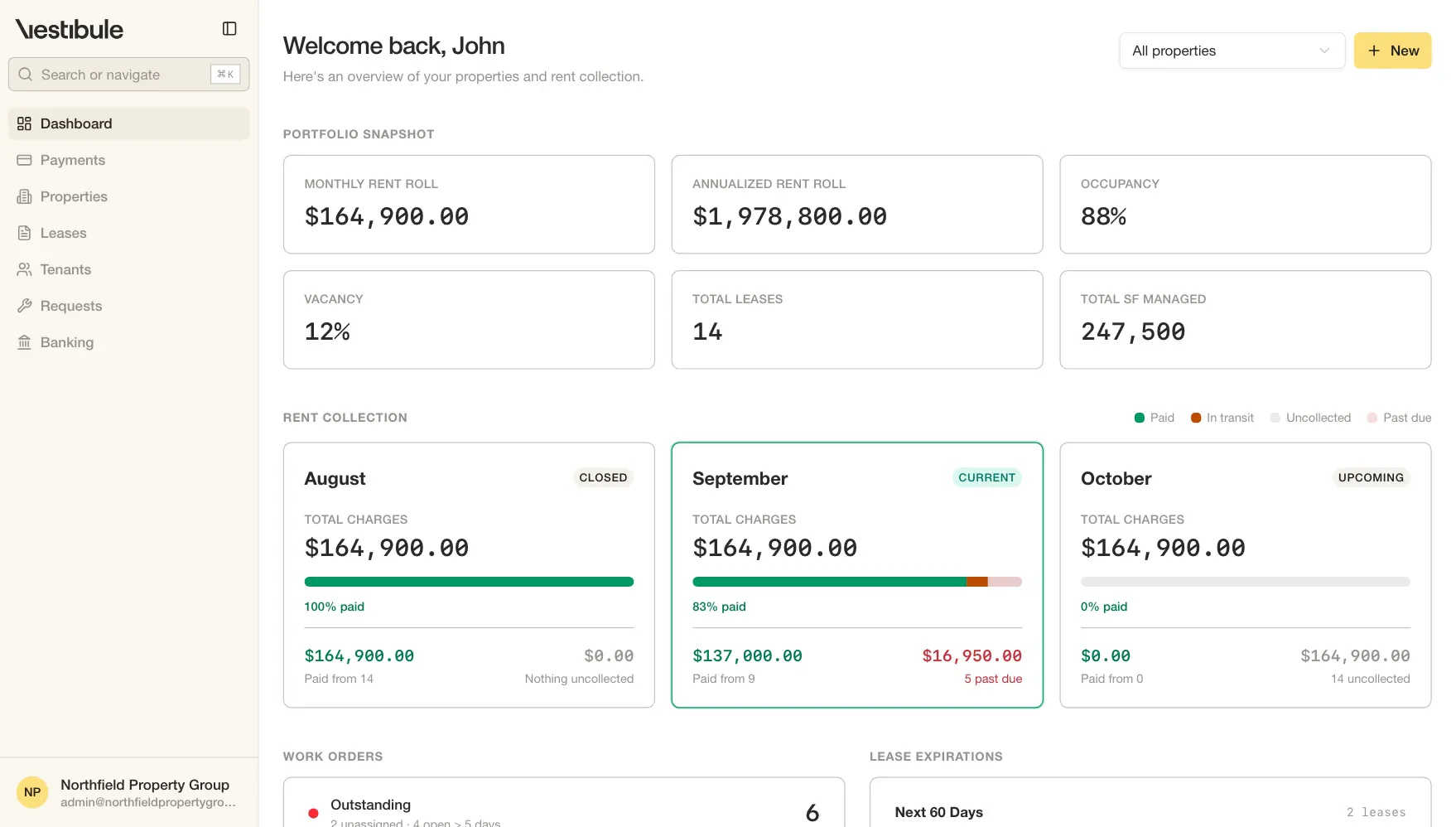
| Portfolio visibility | Month-end packages and ad hoc reports | A current view of collections, lease events, and open issues across properties and entities |
The common thread is that each area is connected to the others and to the accounting system. A payment is tied to the lease it belongs to. A tenant’s history is in one place. An escalation in the lease shows up in what the tenant is billed.
What this looks like in practice: one lease amendment
The value of a connected layer is easiest to see in a routine event. Take an illustrative example: a tenant in 12,000 square feet signs an amendment that extends the term by five years. Base rent stays at $32.00 per square foot ($32,000 a month) for the first year, then increases 3% a year.
In a disconnected setup, the signed PDF goes into a shared drive. Someone emails accounting to update the recurring charges. Someone else updates the critical-dates spreadsheet with the new expiration and renewal option. The tenant gets a copy of the amendment but no updated view of what they’ll owe.
Each handoff is a chance for something to slip. If the first escalation is never entered, the tenant keeps getting billed $32,000 instead of $32,960. Twelve months later, that’s $11,520 in under-billed rent. Recovering it means an awkward conversation with a tenant you just agreed to extend.
In a connected setup, the amendment’s key terms are captured once and reviewed by a person. The new rent schedule, escalation dates, expiration, and renewal option live with the lease record. Charges in the accounting system are updated from that record, and the next escalation shows up as a date someone owns. The tenant can see the new rent before the first bill arrives.
Neither setup removes the need for careful review. The difference is how many times the same information gets re-keyed, and how many people have to remember to do it.
How to start without a big-bang replacement
You don’t need to modernize everything at once. Most landlords get further by starting with the problem that costs them the most time or creates the most risk.
- Pick the most painful workflow. For many teams, that’s rent collection and reconciliation. For others, it’s lease data scattered across PDFs.
- Keep the accounting system where it is. Choose tools that work alongside it instead of asking the accounting team to switch.
- Start with one property or one entity. Prove the workflow, then roll it out across the portfolio.
- Bring tenants along. Tell them what’s changing, why, and how it makes their life easier. A clear onboarding message does more for adoption than any feature.
- Measure what changed. Track time spent on reconciliation, payment exceptions, work order response times, and tenant questions, before and after.
The bottom line
The modern commercial landlord doesn’t just collect rent and manage leases. They give tenants a better experience while gaining clearer visibility and control over their properties.
That doesn’t require replacing the accounting system. It requires connecting the daily work, including leases, payments, tenant communication, and building operations, so it stops living in inboxes and spreadsheets.
That’s what Vestibule is built to do. Vestibule gives commercial landlords one connected place for lease data, rent collection, tenant communication, and work orders. Its AI assistant helps abstract both original leases and amendments, and your team reviews the results. Vestibule integrates with Yardi, MRI, and AppFolio, so the accounting system you already use stays your system of record.
See how Vestibule works alongside your accounting system. Explore how Vestibule connects leases, payments, and tenant service, or request a demo.
Related reading
- Does Better Tenant Experience Lead to Higher Commercial Lease Renewals? What the research says about tenant satisfaction and renewals.
- Why Every Commercial Landlord Should Offer a Branded Tenant Portal. How landlords can deliver a better day-to-day experience.
- Electronic Rent Collection. How ACH and card payments work for commercial rent.
- Commercial Lease Abstraction. What belongs in a lease abstract and how to keep it current.
Sources
- Nacha. Same Day ACH and Business-to-Business Payments Propel ACH Network Volume Growth in 2025. January 2026.
- Association for Financial Professionals. Survey: 79% of Organizations Were Victims of Attempted or Actual Payments Fraud Activity in 2024. April 2025.