ResourcesTenant Experience, Transparency & Retention
Why Every Commercial Landlord Should Offer a Branded Tenant Portal
A tenant portal should be more than a place to pay rent. What a commercial tenant portal should include, why it should carry your name, and what to ask before choosing one.
Vestibule Editorial
· 9 min read
Most commercial landlords think of a tenant portal as a way to collect rent online. That’s useful, but it undersells what a portal can do.
A good tenant portal is the front door to your management service. It’s where tenants pay, ask questions, request help, find information, and hear from you. Done well, it makes your buildings easier to work with and makes your team look more organized than the landlord down the street.
This article covers what a commercial tenant portal should include, what a well-run service request looks like, why the portal should carry your name, what to ask before choosing one, and how to roll one out without creating more work for your team.
How tenants deal with landlords today
Ask a commercial tenant how they interact with their landlord, and you’ll often hear some version of this: rent goes out by check or a bank transfer someone set up years ago. Maintenance requests go to the building engineer’s cell phone or the property manager’s email. Statements arrive as PDF attachments. Questions go to whoever they know.
From the landlord’s side, it looks similar. Information lives in personal inboxes. When a property manager leaves, the history leaves with them. Nobody has a full picture of what a tenant has asked for, what’s still open, or when management last checked in.
None of this is a crisis. But it makes the landlord harder to work with, and tenants notice. Grace Hill’s KingsleySurveys data consistently ranks satisfaction with management, problem resolution, and communication among the top drivers of overall commercial tenant satisfaction (Grace Hill, 2025). Those are exactly the things a scattered process makes harder.
What a tenant portal should do
A portal that only collects rent solves one problem. A portal that becomes the tenant’s main point of contact solves several. At a minimum, it should let tenants:
- Pay rent and other charges. By ACH or card, with a clear view of what’s owed, what’s been paid, and how payments were applied.
- Submit and track service requests. Tenants can see that a request was received, who’s handling it, and when it’s done.
- Find building and lease information. Statements, building rules, contacts, insurance requirements, and other documents they’d otherwise have to request.
- Communicate with management. Questions go to a shared place the whole team can see, not one person’s inbox.
- Receive notices. Building announcements, planned outages, and policy changes reach the right tenant contacts.
The point isn’t to add features. It’s to give tenants one predictable place to go, so they don’t have to remember who to call for what.
What a well-run service request looks like
Service requests are where a portal earns tenants’ trust or loses it. Here’s an illustrative example.
At 6:40 p.m. on a Thursday, the office manager for a 15-person law firm submits a request: the HVAC in their suite shut off and the space is getting warm. The building runs HVAC until 6:00 p.m. on weekdays, and the firm has a filing deadline that night.
A service request isn't done until the tenant confirms it's fixed
not fixed: reopen
01 · Submitted
Issue, location, photo.
02 · Acknowledged
Owner and expected timing.
03 · Dispatched
Engineer or vendor assigned.
04 · Completed
Work notes recorded.
05 · Closed out
Tenant confirms it's fixed.
The tenant can see the status at every step
A well-run process handles that request in five steps:
- Submitted. The tenant describes the issue and location, and can add a photo. No phone tag.
- Acknowledged. Someone confirms receipt, names who owns it, and sets expectations. In this case, that includes explaining that after-hours HVAC can be scheduled and whether the lease charges for it.
- Dispatched. The engineer or vendor gets the details without anyone retyping them.
- Completed. The work and any after-hours charge are recorded against the request.
- Closed out. The tenant confirms the issue is fixed. If it isn’t, the request reopens instead of a new one starting from scratch.
The operational lesson: a request isn’t done when the engineer leaves. It’s done when the tenant agrees it’s done. And if the same suite keeps asking for after-hours HVAC, that’s worth a conversation about their schedule, not just another ticket.
Why your name should be on it
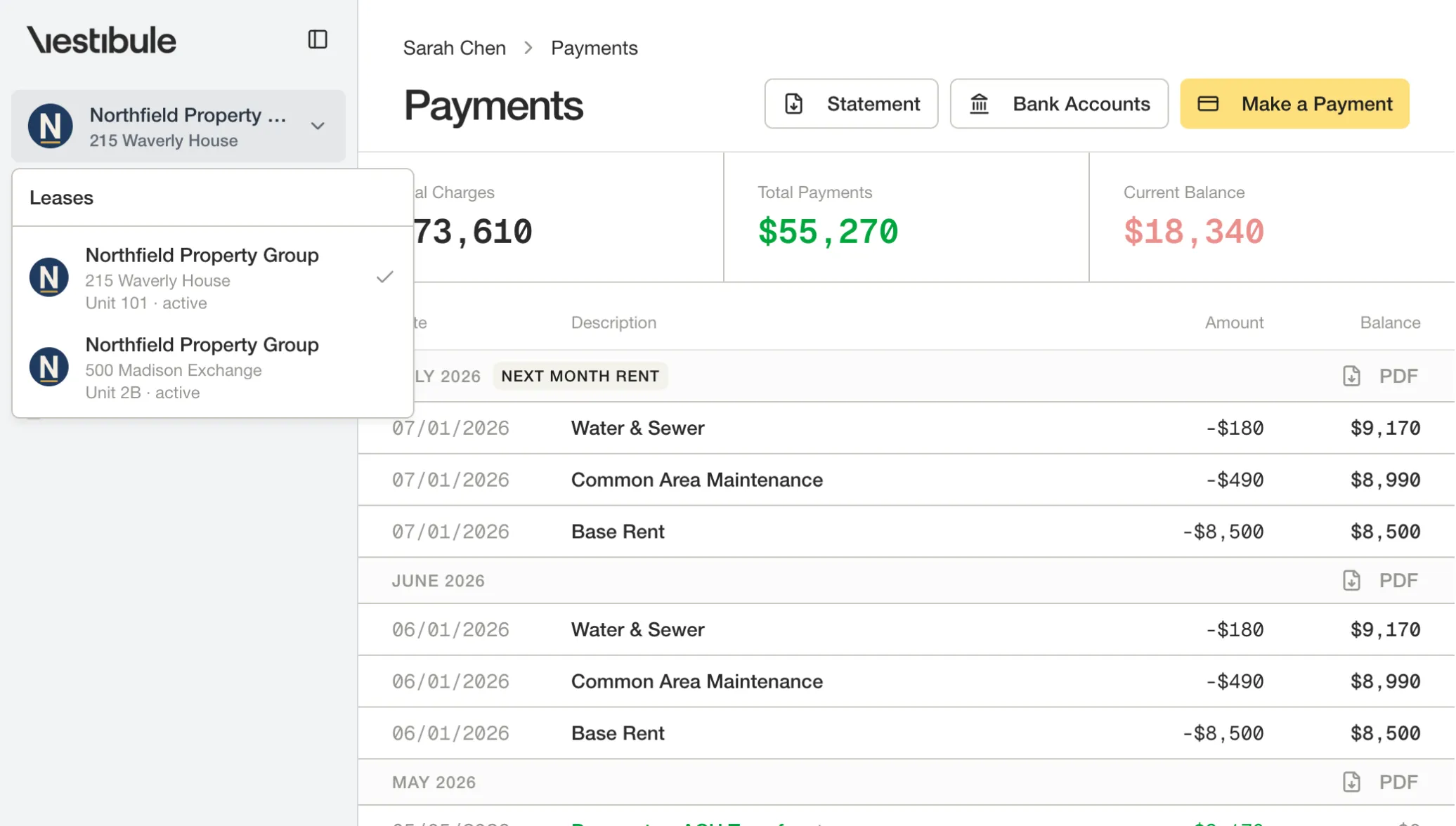
When a tenant logs in to pay rent, whose name do they see? For many landlords, it’s a payment processor or a software vendor the tenant has never heard of.
That matters more than it seems. The tenant relationship belongs to the landlord, and the portal is where tenants interact with you most often. A portal that clearly shows your name and identity feels like part of your service rather than a third-party checkout page.
It also helps with trust. Tenants are rightly cautious about entering bank details into an unfamiliar site, especially when payment fraud and email scams target businesses so often. A portal that clearly comes from their landlord, introduced by a message from you in advance, is easier to adopt.
Branding isn’t the most important part of a portal. A well-branded portal that’s hard to use won’t help anyone. But when you compare options, it’s worth asking how the portal will present your company to tenants.
Questions to ask before choosing a portal
Use these questions to compare options, including the one you may already have:
| Area | What to ask |
|---|---|
| Payments | Can tenants pay by ACH and card? Can they see how each payment was applied? |
| Service requests | Can tenants track status? Can a closed request be reopened? |
| Contacts | Can each tenant have several contacts, such as accounts payable, facilities, and the lease signer, with different access? |
| Information | Can tenants find statements, building information, and key documents without asking? |
| Communication | Do questions and notices go to a shared place the team can see? |
| Identity | How does the portal present your company to tenants? |
| Accounting | How does it work with your accounting system, and what has to be entered twice? |
| Rollout | What does tenant onboarding involve, and who handles tenant questions? |
What landlords get out of it
A tenant portal is a service to tenants, but the landlord benefits just as much.
- Less time chasing payments. Electronic payments made through a portal can be tied to specific charges, which cuts down on the guesswork that comes with a check in the mail.
- Fewer lost requests. Every service request has a record, a status, and an owner.
- Shared history. When someone on the team is out, or leaves, the tenant’s history stays with the property.
- Fewer repeat questions. Tenants can find statements and building information themselves.
- A more professional impression. The way you handle everyday service shapes how tenants feel about you long before the renewal conversation.
That last point matters more than it seems. Research on U.S. office tenants has found that higher satisfaction is associated with greater willingness to renew (Hu, Kok, and Palacios, 2026). A portal won’t guarantee a renewal, but it removes some of the everyday friction that wears a relationship down.
Commercial isn’t residential
Many tenant portals were built for apartments, and it shows. Commercial tenants are different, and the portal should reflect that.
- Tenants are businesses. The person paying rent is often in accounts payable, not the person who signed the lease. A portal should support several contacts per tenant with different roles.
- Charges are more complex. Base rent, CAM, taxes, insurance, utilities, and escalations all need to be clear.
- Leases are long and negotiated. Tenants need to see information tied to their specific lease, not a generic resident handbook.
- Relationships matter more. A single commercial tenant can represent a meaningful share of a building’s income. The portal should support the relationship, not replace it.
A commercial tenant portal should feel like a business tool, because that’s how your tenants will use it.
How to roll it out
The hardest part of a tenant portal isn’t the software. It’s getting tenants to use it. A few things make a big difference:
- Tell tenants before they get an invite. A short letter or email from the landlord explaining what’s changing and why builds trust and cuts down on questions.
- Lead with what’s easier for them. Faster payment confirmation, a place to track requests, and documents on demand. Not “we’re moving to a new system.”
- Set up the right contacts. Make sure accounts payable, facilities, and the lease signer each get access to what they need.
- Start with payments and requests. Those are the two things tenants do most often. Add the rest once they’re comfortable.
- Keep a human in the loop. The portal should make your team easier to reach, not harder.
The bottom line
A tenant portal is more than a way to collect rent. It’s where tenants experience your management service day to day. Give them one clear place to pay, ask, request, and find information, and make sure it feels like it comes from you.
Vestibule’s tenant portal is built for commercial leases, and it carries your branding, so tenants see your company rather than a software vendor’s. Tenants can pay rent and see how each payment was applied, submit and track service requests, find statements, documents, and building notices, and communicate with management. Each tenant can have several users with roles such as admin, finance manager, and office manager. Vestibule integrates with Yardi, MRI, and AppFolio, so your accounting system stays your system of record.
See how Vestibule’s tenant portal works. Explore the Tenant Portal or request a demo.
Related reading
- Does Better Tenant Experience Lead to Higher Commercial Lease Renewals? Why everyday service matters to ownership.
- The Modern Commercial Landlord: Why Property Management Needs a New Operating System. Where a portal fits in a connected operating setup.
- Electronic Rent Collection. How ACH and card payments work for commercial rent.
Sources
- Grace Hill. 2025 CRE Emerging Trends Report (KingsleySurveys).
- Hu, M., Kok, N., and Palacios, J. Tenant Satisfaction and Commercial Building Performance. Journal of Real Estate Finance and Economics, 2026.