ResourcesPayments & Collections
How to Collect Commercial Rent Electronically: ACH, Checks, and Credit Cards
A practical guide to commercial rent collection with ACH, AP-system payments, cards and checks, including fees, payment tracking and lease-level reconciliation.
Vestibule Editorial
· 18 min read
For many commercial landlords, collecting rent involves more than waiting for a tenant to pay. One tenant pays through an online portal, another sends an ACH credit from its accounting system, and a third still mails a check. Meanwhile, rent, operating expense reimbursements, electricity, and other charges may all be due under the same lease.
The challenge is not merely offering electronic payments. It is knowing which tenant paid, which lease and charge the payment belongs to, whether the money has actually cleared, and what is still outstanding.
Commercial rent collection works best when landlords provide suitable payment options while keeping one accurate record of charges, receipts, exceptions, and bank activity. This guide explains the main payment methods, how to compare them, and how to build a practical collection and reconciliation process.
Quick answer: What is the best way to collect commercial rent?
There is no single method that fits every commercial tenant. ACH is often a practical default for recurring commercial rent, but landlords may also need to accept bank-originated payments from tenants’ accounts-payable (AP) systems, optional card payments, and paper checks. The most important requirement is that every payment can be reliably linked to the correct tenant, lease, ownership entity, and charge.
| Payment method | Who typically starts it? | Main advantage | What the landlord must manage |
|---|---|---|---|
| ACH debit through a portal | Tenant authorizes a debit, or an authorized recurring payment runs | Repeatable collection workflow | Authorization, timing, returns and payment status |
| ACH credit from a bank or AP system | Tenant sends funds | Fits established corporate AP processes | Remittance details and matching the receipt to a lease |
| Credit or debit card | Tenant pays through an enabled card option | Additional payment choice | Processing costs, disputes and card-security responsibilities |
| Paper check | Tenant mails or delivers a check | Familiar to established tenants | Receipt, deposit, clearing and accurate posting |
The right mix depends on lease terms, tenant payment practices, cost, ownership structure, and the tools available to the landlord.
Start with the lease and the charges—not the payment link
Before changing how tenants pay, make sure the amount due is correct. Commercial leases may require more than monthly base rent. A statement can include scheduled escalations, common area maintenance (CAM), real estate tax reimbursements, utilities, HVAC charges, or other amounts allowed by the lease.
A sound workflow connects four records:
- Lease: What is contractually due, and when?
- Charge: What was billed to the tenant for this period?
- Payment: What did the tenant initiate or send?
- Ledger and bank record: What cleared, how was it applied, and what remains due?
If a tenant pays electronically but the team cannot determine which charges were satisfied, the landlord has improved payment convenience without solving the underlying accounting problem.
For more on the underlying rent schedules and provisions, see Commercial Rent Escalations Explained and Commercial Lease Abstraction.
1. ACH payments through a tenant portal
The Automated Clearing House (ACH) network moves electronic credit and debit payments between U.S. financial institutions. The Federal Reserve describes ACH as a nationwide system for electronic transfers, including payments initiated as credits and debits.
With an ACH debit, a tenant authorizes an eligible landlord or payment provider to pull an amount from the tenant’s bank account. The tenant might initiate a one-time payment in a portal or authorize recurring rent payments under agreed terms.
For recurring commercial rent, ACH can reduce repetitive manual payment work and give tenants a consistent payment process. It is especially useful when the same tenant pays rent every month.
However, landlords should establish the right authorization process, review settlement cutoffs and holidays, and know how their provider handles unsuccessful or returned transactions. Business ACH authorizations and consumer authorizations do not necessarily follow identical rules. A payment initiated today should not automatically be treated as irrevocably collected today.
Questions to answer before enabling ACH: Which entity receives funds? Who authorizes debits? What are the applicable limits and fees? When is payment considered received under the lease and provider agreement? How are returns, reversals, and disputes handled?
2. ACH credits from the tenant’s bank or accounts-payable system
Many commercial tenants already have controlled AP systems. Their finance departments may prefer to push an ACH credit to the landlord rather than authorize a third party to debit their account.
This is different from a portal-originated ACH debit:
- ACH debit: An authorized collector initiates the debit against the tenant’s account.
- ACH credit: The tenant or its bank initiates the transfer into the landlord’s account.
Both use the ACH network, but they differ in who controls initiation and what information may arrive with the funds.
Why AP-system payments are harder to match
Imagine a management company receiving deposits for several LLC-owned properties. A tenant’s AP system sends $26,000, but the bank statement shows only an abbreviated originator name and a transaction reference. The landlord must still identify the tenant, receiving entity, lease, and charges.
Business ACH formats such as CCD and CTX can carry remittance information, but the availability and accessibility of those details depend on the payment setup and the data delivered to the receiving party.
The practical solution is to give the tenant’s finance team a stable lease or account reference, maintain accurate payee details, and establish a process for exceptions when remittance data is incomplete. Avoid relying on the tenant’s legal name alone as the only matching key.
For rent-diversion protection, any changes to bank or remittance details should be authenticated through an independently verified channel, rather than trusted solely because they arrive by email.
3. Card payments: an option, not necessarily the default
Some commercial tenants value the ability to pay by credit or debit card. Landlords may choose to offer card payments as an additional method, especially for certain balances or situations where the option is useful to the tenant.
There are important tradeoffs. Card processing can have a different cost structure from ACH, and card transactions may be subject to disputes or chargebacks. A landlord should also understand the applicable payment-card security and compliance responsibilities.
Do not assume the landlord can automatically pass every card fee to the tenant. Whether a surcharge or convenience fee is available—and how it must be disclosed—depends on the program, card-network rules, applicable law, lease terms, and processor requirements.
Before enabling cards, confirm the actual card types accepted, fees, settlement timing, refund handling, and dispute process. Use a reputable payment provider, and do not collect or store tenants’ card numbers in ordinary email or spreadsheets.
The PCI Security Standards Council notes that outsourcing card processing does not automatically remove all of a merchant’s responsibilities for protecting payment information and overseeing payment providers.
4. Paper checks: still part of commercial rent collection
Electronic payments are growing, but paper checks remain common in business-to-business transactions. A September 2026 Federal Reserve Bank of Kansas City research briefing notes that almost 90% of businesses still use checks for at least some B2B payments.
For a commercial landlord, that means modernization should not require forcing every tenant onto one payment method overnight.
A paper-check process still needs reliable controls:
- Record when and from whom the check was received.
- Identify the property, tenant, lease, and amount.
- Deposit the check according to the authorized banking process.
- Monitor whether it clears or is returned.
- Apply the receipt to the correct open charges.
- Retain the documentation needed for audit and dispute resolution.
Scanning a check can reduce manual entry, but scanning, depositing, and collecting are not identical events. A landlord should confirm that a check was properly deposited and monitor returns and possible duplicates.
Vestibule’s published Payments page describes a workflow in which checks arrive at the landlord’s office, are scanned, and are matched to the appropriate lease and bank account. This means a landlord can accommodate established check-paying tenants without treating those receipts as an entirely separate spreadsheet process.
01 · Portal ACH
The tenant authorizes a debit through the portal.
02 · Bank or AP ACH
The tenant sends a credit from its own bank or accounts-payable system.
03 · Card, optional
Accepted only where the landlord has chosen to enable it.
04 · Paper check
Received at the office and scanned.
All four arrive at one place
Each receipt is matched to the tenant, the lease and the charges it pays — or held as an exception until someone decides where it belongs.
Illustrative workflow. Actual settlement, matching, and exceptions depend on the payment method and provider.
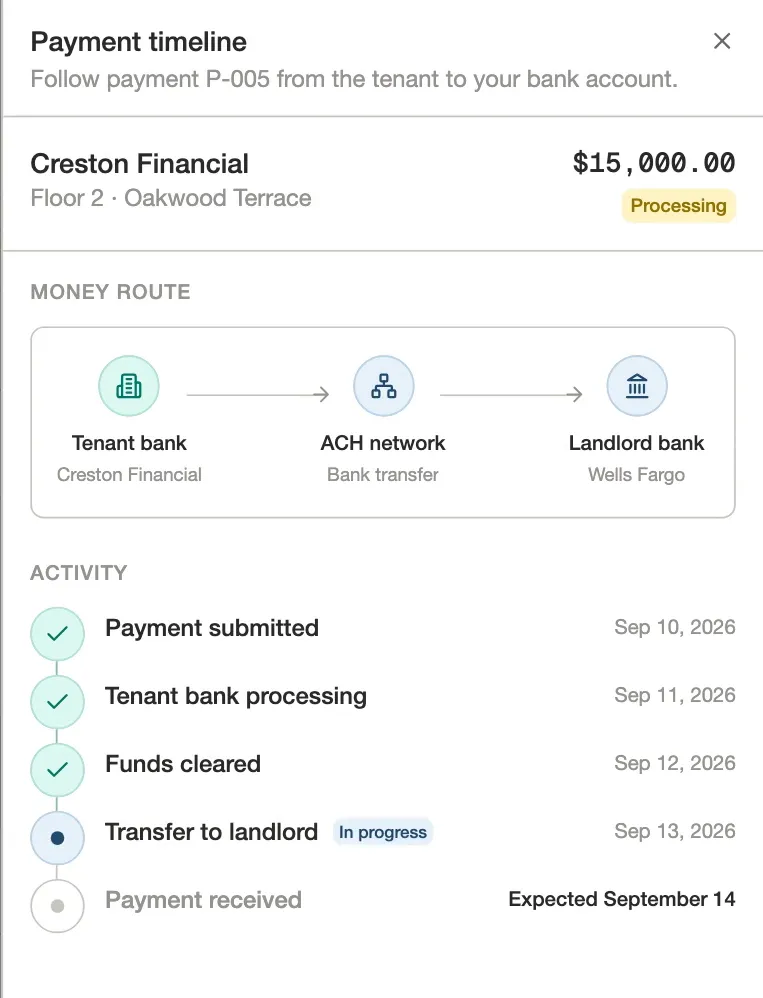
Payment initiated, processing, cleared, and reconciled: what’s the difference?
A payment confirmation does not always mean funds are already available and correctly reflected in the books.
Different platforms use different status labels, but property teams should understand at least these distinctions:
| Stage | What the team knows | What it should not assume |
|---|---|---|
| Due | A charge remains payable | That the tenant has begun paying |
| Initiated | Payment instructions have been submitted | That funds have settled |
| Processing | A bank or processor is handling the payment | That the payment cannot fail or return |
| Cleared or settled | Funds have posted or settled under the relevant process | That every accounting entry and allocation is correct |
| Reconciled | Receipt and charges have been matched to the ledger and bank records | That all future reversals or disputes are impossible |
These are operational distinctions, not standardized status names used by every provider.
Why this matters: A tenant who has initiated an ACH payment may warrant a different follow-up from a tenant who has done nothing. But neither should be recorded as fully collected merely because a payment attempt appears on screen.
A payment can fail or be returned at any point before it is reconciled, and a return after clearing puts it back into exception handling.
An effective collections dashboard distinguishes a payment in progress from collected funds and records exceptions separately.
How to reconcile commercial rent when tenants pay in different ways
Payment reconciliation means matching receipts to the correct tenants, leases, and outstanding charges, and checking that the resulting records agree with banking and accounting activity.
The process matters whether payments originate through a portal, a corporate AP system, a card processor, or a check deposit.
Example: A tenant makes a partial payment
Assume a hypothetical office tenant owes the following charges this month:
| Charge | Amount |
|---|---|
| Base rent | $24,000 |
| CAM reimbursement | $1,600 |
| Electricity | $400 |
| Total amount due | $26,000 |
The tenant sends an ACH credit of $25,600.
The difference is $400. That balance remains outstanding unless there is a valid credit, adjustment, or other permitted treatment. Which charges the receipt satisfies must be determined using the lease, remittance instructions, and applicable payment-allocation policy; the payment amount alone does not establish the allocation.
Base rent $24,000 + CAM $1,600 + electricity $400
$400 still outstanding — the gold sliver, drawn to the same scale
Illustrative amounts only. A partial payment should not automatically result in a paid-in-full status.
A practical reconciliation checklist
- Confirm the tenant, lease, property, and receiving legal entity.
- Confirm the billed charges agree with the executed lease and amendments.
- Identify the payment method, date, amount, and transaction reference.
- Distinguish initiated or processing payments from cleared receipts.
- Apply the receipt to the appropriate charges using the governing rules.
- Record partial payments, unapplied funds, credits, and exceptions explicitly.
- Reconcile the tenant ledger and deposit activity with the accounting system.
- Investigate missing remittance references, returned payments, and duplicate postings.
- Retain an audit trail for corrections and approvals.
The accounting system should remain authoritative for the general ledger and financial close. A payment platform should reduce the manual work required to get reliable transaction information into that accounting workflow.
Multiple buildings and LLCs: keep the receiving entity correct
Commercial portfolios are often held through separate property-owning LLCs. Even when one team manages collections across the entire portfolio, payments may need to be directed to different bank accounts and applied to different legal entities.
A landlord should be able to answer, for each receipt:
- Which ownership entity is entitled to receive it?
- Which property and lease generated the charge?
- Which bank account actually received the funds?
- Is the receipt rent, a reimbursement, a security deposit, or another category?
- How will the transaction appear in the correct accounting ledger?
Security deposits require particular care. They should not be casually mixed with operating rent receipts; follow the lease, applicable law, banking requirements, and the property’s accounting policies.
A portfolio-wide dashboard is helpful only if it also preserves the distinctions between individual entities and bank accounts.
What does electronic commercial rent collection cost?
There is no universal processing price that applies to every landlord or payment method. Vendors and banks may structure fees differently.
When evaluating a provider, ask for the complete commercial fee schedule, including:
| Cost question | Why to ask |
|---|---|
| ACH transaction fee | May depend on the provider, account, or payment value |
| Card processing | May involve percentage and per-transaction components |
| Failed or returned payments | Determines the cost of exceptions |
| Refunds and chargebacks | Important if accepting cards |
| Check handling or deposit | May create separate operational or banking charges |
| Software subscription and minimums | Different from the cost of moving money |
| Who pays each fee | Must align with program terms, applicable law, and the lease |
Compare total administrative work and reliable reconciliation, not just headline processing rates. A nominally inexpensive payment channel can be costly to manage if every incoming deposit must be researched and posted by hand.
For Vestibule specifically, its publicly stated subscription pricing is $12 per active lease per month. Do not confuse that software subscription with a verified ACH or card processing quote; ask the team for the current transaction-fee schedule and payer responsibilities. See Vestibule pricing.
How to move commercial tenants toward electronic payments
A transition works best when it respects how commercial tenants already pay and gives the property team a dependable fallback.
Step 1 — Verify rent instructions and lease obligations. Confirm the payee, legal entity, banking controls, due dates, and any lease limitations on payment methods.
Step 2 — Map existing payment behavior. Identify who pays by bank ACH, AP-system credit, portal, card, or check. The largest tenants may have their own corporate payment-approval requirements.
Step 3 — Offer an appropriate electronic default. Make ACH understandable and easy to use while preserving other approved channels where needed.
Step 4 — Communicate securely. Explain how to access the tenant portal, where statements appear, how to identify the correct payee, and whom to contact for questions. Authenticate any changes to banking instructions through a trusted channel.
Step 5 — Test the first cycle. Confirm payment initiation, deposit receipt, tenant matching, and accounting posting instead of assuming that the initial setup guarantees a clean reconciliation.
Step 6 — Create an exception process. Assign responsibility for returned ACH payments, incorrect amounts, unidentified deposits, unapplied receipts, and disputed charges.
Step 7 — Measure the result. Track successful collections, outstanding balances, manual exceptions, and the time it takes to reconcile each payment cycle.
A successful transition is not measured only by the percentage of tenants using an online portal. It is measured by how accurately and efficiently the property team can administer every receipt.
Where Vestibule fits
Vestibule is a commercial landlord operating platform built to connect leases, tenant statements, payments, and portfolio visibility.
According to its published Payments and Tenant Portal pages, Vestibule supports ACH and bank/AP-system payment workflows and check collection, and its published pricing answers state that landlords can also choose to accept card payments. It provides payment-status visibility, matches receipts to leases and charges, and supports workflows alongside existing accounting platforms, including Yardi, MRI, and AppFolio, as well as CSV exports.
For landlords, the value is not simply offering another way to pay. It is reducing the gap between what the lease says is due, what the tenant actually sent, and what ownership and accounting can confirm has been collected.
That is particularly relevant for landlords overseeing multiple commercial buildings, separate ownership entities, and tenants with different payment practices.
Explore Vestibule Payments, see the Tenant Portal, or request a demo to review the available workflows for your portfolio.
Frequently asked questions
Can a commercial tenant pay rent by ACH from its own bank?
Yes, subject to the landlord’s accepted payment arrangements. A business tenant can often send an ACH credit from its bank or AP system. That differs from authorizing an ACH debit through a payment portal. The landlord still needs sufficient remittance information to identify the payment and apply it correctly.
Is ACH the same as a wire transfer?
No. ACH and wire transfers use different payment networks and have different processing, timing, pricing, and risk characteristics. Landlords should verify which methods they accept and provide accurate payment instructions through secure channels.
Are ACH rent payments instant?
Not necessarily. Some ACH payments can settle on the same banking day, while others settle later, depending on how and when they are submitted. Settlement timing is not the same as an absolute guarantee that a transaction cannot later be returned or disputed.
Can commercial landlords accept credit cards for rent?
Yes, if card acceptance is supported and enabled through the landlord’s payment program. Before offering it, review card processing charges, permitted fee practices, chargeback handling, and applicable security responsibilities.
Should landlords stop accepting paper checks?
Not necessarily. Some commercial tenants still pay through established check processes. A landlord may prefer to encourage electronic payments while maintaining an orderly, auditable way to record, deposit, clear, and reconcile approved checks.
What happens when a tenant’s ACH payment fails or is returned?
The payment should be treated as an exception, with the ledger and tenant balance reviewed and corrected as appropriate. Any return fee or late charge depends on the applicable banking or processor terms, lease language, and law; it should not be assumed that every failed payment can be charged to the tenant.
Does a rent collection platform replace property accounting software?
Not necessarily. A well-designed collections workflow can complement an existing accounting system by organizing charges, receipts, status updates, and transaction details. The controller’s accounting system can remain the general-ledger system of record.
Key takeaway
Electronic commercial rent collection is not just the act of moving money into a bank account.
Landlords need reliable charges based on their leases, convenient ways for tenants to pay, clear visibility into processing and cleared funds, and accurate matching of receipts to the correct tenants and ownership entities.
The goal is one dependable collections process, regardless of how the tenant sends the rent.
Sources and further reading
- Federal Reserve Board — Automated Clearinghouse Services
- Nacha — How ACH Payments Work
- Nacha — ACH Guide for Developers: How ACH Works
- Federal Reserve Bank of Kansas City — B2B Payments: A Gradual Shift from Checks to Electronic Payment Methods (2026)
- PCI Security Standards Council — Outsourced Payment Processing and Merchant Responsibilities
This guide is educational and does not constitute legal, accounting, tax, banking, or payment-compliance advice. Verify lease terms, processing agreements, payment-network requirements, and applicable law before changing a collections program.