ResourcesLease Management
Commercial Lease Abstraction: What Every Landlord Should Track
Learn what a commercial lease abstract should include, from rent schedules and renewal notices to CAM, security deposits, and AI review, with a practical checklist.
Vestibule Editorial
· 25 min read
A commercial lease might be 20 pages or more than 100. It may contain rent schedules, free-rent concessions, renewal options, operating expense provisions, insurance requirements, and dozens of obligations that continue for years after the agreement is signed.
For a commercial landlord, the challenge isn’t necessarily having access to the lease. It’s knowing what’s in it—and being able to act on that information when it matters.
When does rent increase? Which tenants have renewal options? Who is responsible for replacing the HVAC equipment? When can a security deposit be reduced? How much annual rent is scheduled to expire over the next 18 months?
The answers are usually somewhere in the executed lease, its exhibits, and subsequent amendments. But finding them shouldn’t require rereading the entire document every time a question arises.
That’s where commercial lease abstraction comes in.
This guide explains what a commercial lease abstract should include, how to prepare one, which provisions deserve additional attention, and how modern lease management software can help commercial landlords maintain accurate information across their portfolios.
What is commercial lease abstraction?
Commercial lease abstraction is the process of reviewing a lease and extracting its important financial, operational, and legal terms into a structured summary that can be used to manage the property.
The resulting document or data record is called a lease abstract.
Rather than functioning as a shortened copy of the lease, a useful abstract organizes the information that landlords and property managers need to make everyday decisions.
That typically includes:
- The landlord and tenant’s legal names.
- The building, suite, and rentable square footage.
- Lease commencement, rent commencement, and expiration dates.
- Base rent and annual escalation schedules.
- Free-rent concessions and security deposits.
- Operating expense, tax, and utility obligations.
- Renewal, termination, expansion, and contraction rights.
- Insurance, maintenance, and repair responsibilities.
- Notice deadlines and other important dates.
- Relevant references to the governing lease provisions.
The documents
The executed lease, its exhibits, amendments, commencement agreements and side letters — together, the operative terms.
The structured record
- Parties, premises, square footage
- Commencement, rent commencement, expiration
- Base rent and escalation schedule
- Additional rent and expense provisions
- Options and notice deadlines
- Maintenance and insurance obligations
- Source reference and review status for each
What it answers
- What should this tenant be billed?
- Which deadline is coming, and for whom?
- Who is responsible for this repair?
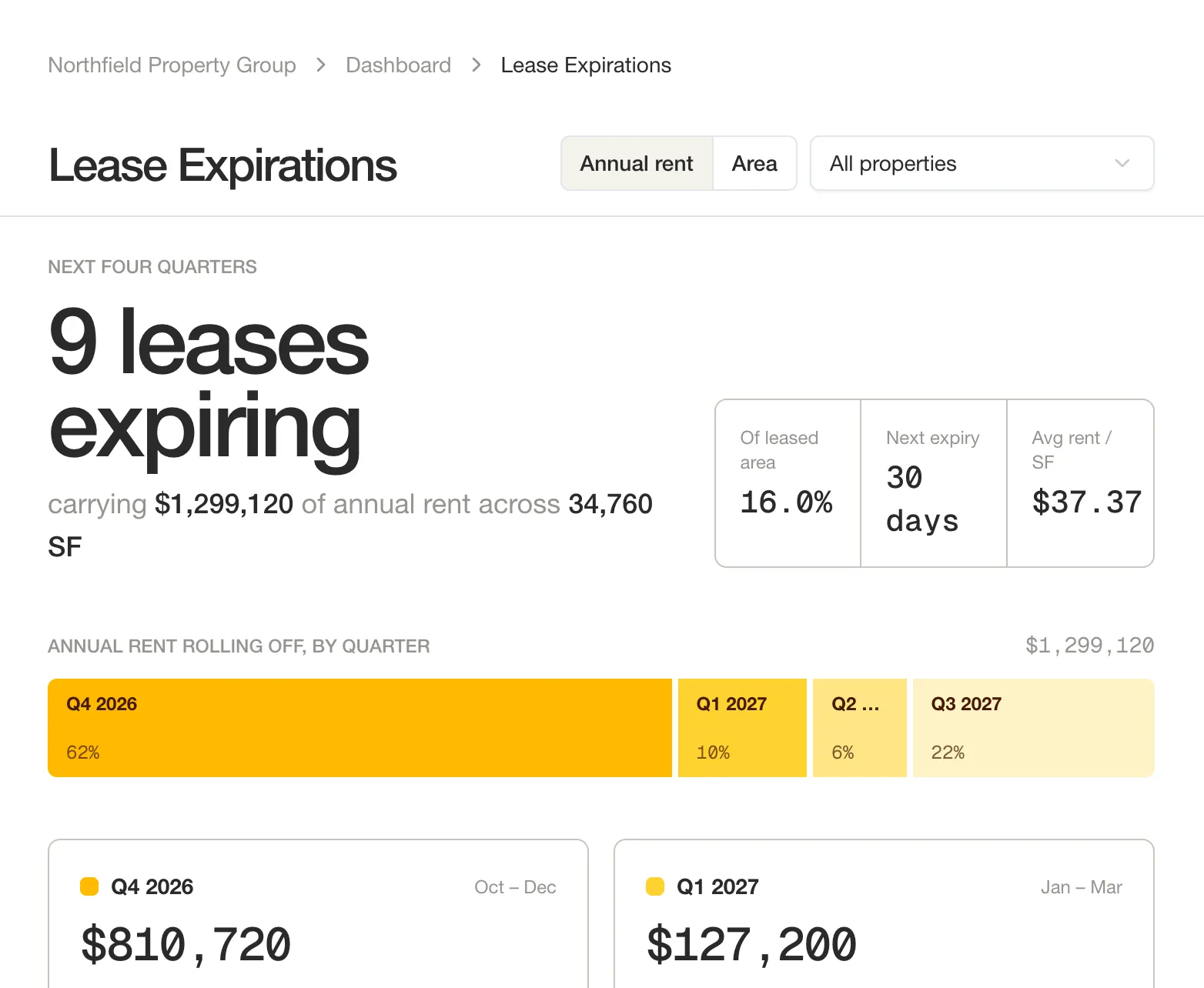
- What is expiring, and what is it worth?
The most useful lease abstract answers three questions: What does the lease require, when does it matter, and where can I verify it?
A commercial lease abstract should not replace the executed agreement. The signed lease, amendments, and other applicable documents remain the source of contractual obligations.
Why lease abstraction matters for commercial landlords
A landlord managing a single small building may know most tenants and their lease terms from memory.
That becomes increasingly difficult when a portfolio includes multiple properties, ownership entities, tenants, and lease structures.
Consider a landlord with 150 commercial leases.
Some tenants have fixed annual increases. Others have CPI adjustments. Several receive free rent at different points in their terms. A few have termination rights, and others have renewal options requiring notice nine or twelve months before expiration.
Different leases may allocate HVAC, cleaning, electricity, and operating expenses differently.
The landlord’s accounting team needs to know what to bill. Property management needs to understand responsibilities. Asset management needs to know which leases are expiring. Ownership needs a reliable picture of income and future exposure.
Without structured lease information, these teams may maintain separate spreadsheets and document repositories.
The problem isn’t simply duplicated work. It’s that different people can end up working from different interpretations of the same lease.
Five ways accurate lease abstracts help property teams
1. Improve billing accuracy. Rent commencement dates, scheduled increases, and additional-rent obligations can be checked against tenant charges.
2. Prevent overlooked deadlines. Teams can track expirations and contractual notice windows before important decisions become urgent.
3. Clarify responsibilities. Property managers can identify whether specific maintenance, cleaning, utility, or repair costs fall to ownership or the tenant.
4. Support asset management. Owners can review lease expirations, contracted rent, security deposits, and potential rollover exposure across properties.
5. Simplify transitions and due diligence. A consistent abstract makes it easier to onboard a new manager, prepare for refinancing, or review a property acquisition.
Lease abstraction is the foundation for those activities. Ongoing lease administration is what keeps the information current and ensures the appropriate actions are taken.
What should a commercial lease abstract include?
There is no single universal abstract that works for every commercial lease.
An office lease, retail lease, industrial lease, and ground lease may require different levels of detail.
However, most commercial landlords should capture the following information.
Commercial lease abstraction checklist
| Category | Information to capture | Why it matters |
|---|---|---|
| Parties and premises | Landlord, tenant, guarantor, building, suite, square footage | Confirms who occupies what space |
| Lease term | Execution, commencement, rent commencement, expiration | Establishes key dates |
| Base rent | Initial rent, monthly charges, rentable SF, payment terms | Supports accurate billing |
| Escalations | Fixed increases, CPI provisions, percentage rent, effective dates | Identifies future rent changes |
| Concessions | Free rent, abatement, tenant improvement allowances | Distinguishes contractual rent from amounts payable |
| Additional rent | CAM, operating expenses, taxes, insurance, utilities | Identifies recoverable charges |
| Security | Deposits, letters of credit, reductions, return conditions | Tracks security obligations |
| Options | Renewal, termination, expansion, contraction, ROFO, ROFR | Preserves contractual rights |
| Maintenance | HVAC, plumbing, electrical, structural, cleaning | Clarifies responsibility |
| Insurance | Coverage requirements, additional insured provisions, COIs | Helps track contractual requirements |
| Transfer rights | Assignment, subletting, consent, recapture, profit-sharing | Supports leasing and ownership decisions |
| Default and surrender | Cure periods, holdover, restoration, delivery obligations | Helps manage risk at key events |
A useful abstract also records the source document, page or section, and verification status for each material term.
Let’s look at the most important categories in greater detail.
1. Parties, ownership entities, and premises
Start with the basic identifiers.
This sounds simple, but property portfolios frequently contain multiple legal entities, related tenants, affiliated guarantors, and similarly named properties.
Capture:
- The landlord’s exact legal entity.
- The tenant’s exact legal entity.
- Any guarantor and applicable guaranty.
- Property address and building identifier.
- Floor, suite, or other demised premises description.
- Rentable square footage.
- Permitted use.
- Lease execution date.
- The governing lease and amendment history.
For example, ownership may hold three buildings under three separate LLCs while using one management company to administer the portfolio.
The lease abstract should preserve the actual contracting landlord instead of assuming the management company is the landlord.
Likewise, a tenant may conduct business under a brand name that differs from the legal entity signing the lease.
These distinctions become important for billing, payments, notices, enforcement, and due diligence.
Practical tip: Verify legal names against the executed agreement and relevant amendments, not just an existing rent roll or tenant directory.
2. Lease commencement, rent commencement, and expiration dates
These are among the most important fields in a commercial lease abstract.
They are also frequently confused.
Lease commencement date
The date on which the contractual lease term begins, as established by the agreement or applicable commencement documentation.
Rent commencement date
The date on which the tenant becomes obligated to begin paying specified rent.
This may differ from the lease commencement date because of free rent, construction periods, delivery conditions, or other negotiated concessions.
Lease expiration date
The date on which the current term ends, unless the lease is extended, renewed, terminated, or otherwise modified.
A lease might be executed in October, commence in January, and begin collecting base rent in April.
Those dates serve different purposes and should be recorded separately.
Additional dates to capture
Depending on the lease, track:
- Possession or delivery date.
- Substantial completion or landlord-work milestones.
- Rent abatement start and end dates.
- Annual escalation dates.
- Renewal and termination notice windows.
- Expansion or contraction option dates.
- Tenant improvement allowance submission deadlines.
- Security deposit or letter-of-credit reduction dates.
If a date depends on an event rather than a fixed calendar day, record the triggering event and the method for determining the date.
For instance, if rent begins 90 days after substantial completion, the abstract should not invent a definitive date before the triggering event is established.
3. Base rent, escalations, and free rent
A commercial lease abstract should include the complete contractual rent schedule, not simply the initial monthly rent.
Capture:
- Base rent per rentable square foot, where applicable.
- Annual base rent.
- Monthly base rent.
- Payment frequency and due date.
- Each scheduled increase.
- The calculation method for increases.
- Effective dates.
- Free-rent periods.
- Whether concessions apply to base rent alone or additional charges.
Example: A five-year office lease
Consider this hypothetical lease:
- Premises: 4,000 rentable square feet.
- Starting annual rent: $72 per rentable square foot.
- Lease term: January 1, 2027, through December 31, 2031.
- Free base rent: January through March 2027.
- First base-rent payment: April 1, 2027.
- Base-rent increases: 3% each January 1, beginning in 2028.
The initial annual base rent is:
4,000 SF × $72 = $288,000
The initial monthly base rent is:
$288,000 ÷ 12 = $24,000
Assuming the first three months of base rent are fully abated, base rent payable during 2027 is:
$24,000 × 9 months = $216,000
The next annual increase is:
$288,000 × 1.03 = $296,640
That makes the monthly base rent beginning January 1, 2028:
$24,720
A useful abstract would show the distinction:
| Item | Contractual amount |
|---|---|
| Year 1 annualized base-rent rate | $288,000 |
| Year 1 base rent payable after three free months | $216,000 |
| Year 2 annual base rent | $296,640 |
| Year 2 monthly base rent | $24,720 |
Illustrative example only. Assumes three full months of base-rent abatement, no partial-month prorations, and no additional rent. These are contractual cash-billing figures, not a calculation of revenue recognition under accounting standards.
Why does this matter?
An owner might ask what the tenant’s current annualized rent is. An accountant might ask how much base rent should actually be collected in 2027. An asset manager might ask what the tenant is paying in 2028.
Those are different questions, and a properly maintained abstract should help answer all three.
For a deeper explanation of fixed increases, CPI calculations, and percentage rent, see Commercial Rent Escalations Explained.
4. Operating expenses, CAM, taxes, and utilities
Base rent is only one part of many commercial leases.
Depending on the structure, tenants may also be responsible for certain operating expenses, real estate taxes, insurance, electricity, water, cleaning, or other property-related charges.
An abstract should identify the applicable expense structure before recording the financial details.
Common commercial lease structures
Full-service gross: The stated rent generally incorporates designated building operating costs, subject to the lease’s specific exclusions and adjustment provisions.
Modified gross: Base rent incorporates some expenses, while specified additional costs or increases may be charged separately.
Triple net (NNN): The tenant generally pays specified property taxes, insurance, and operating expenses in addition to base rent, subject to the lease’s definitions and exceptions.
These are broad market labels—not substitutes for the actual lease language.
What to abstract from operating expense provisions
| Provision | What to record |
|---|---|
| Operating expense definition | Which costs are included or excluded |
| Base year or expense stop | The applicable reference year or threshold |
| Tenant’s proportionate share | Percentage or calculation method |
| CAM or operating expense cap | Whether it applies to particular expense categories and how it is calculated |
| Real estate tax adjustments | Base amount, share, exclusions, and adjustment mechanism |
| Electricity | Direct meter, submeter, inclusion, or other billing method |
| Cleaning | Building-provided or tenant-responsible |
| HVAC | Included hours, overtime charges, maintenance and replacement obligations |
| Reconciliation | Estimated payments, year-end adjustment, and billing dates |
| Audit or dispute rights | Applicable deadlines, records access, and procedures |
For a landlord managing multiple office buildings, this section can be especially valuable.
One tenant’s lease may require the landlord to maintain the base-building HVAC equipment while the tenant maintains supplemental cooling units.
Another tenant may have a completely different allocation of responsibility.
A lease abstract should reflect those distinctions rather than applying a building-wide assumption to every tenant.
Important: Recording an expense provision is not the same as calculating an annual CAM reconciliation. The lease abstract supplies the contractual rules; the underlying financial records and expense calculations are still required.
5. Security deposits, letters of credit, and guarantees
Security provisions deserve their own section because they affect both financial administration and tenant credit exposure.
Capture:
- Original cash security deposit.
- Current required security amount.
- Whether security is held in cash or through a letter of credit.
- Letter-of-credit expiration and renewal requirements.
- Any scheduled security reductions.
- Conditions for reduction or return.
- Applicable guaranties.
- Any limitations, termination conditions, or release provisions.
Example: A security deposit reduction
Suppose a lease requires a $75,000 security deposit at signing.
The tenant may be entitled to a reduction to $50,000 after the third lease year, provided there have been no specified defaults and other contractual conditions are satisfied.
A useful abstract would capture the amount, potential reduction date, conditions, and relevant source clause.
Simply recording “$75,000 security” misses an important future obligation.
Likewise, the abstract should distinguish a contractual security deposit from an actual account balance. Those amounts must be reconciled against financial and banking records.
6. Renewal options, termination rights, and notice deadlines
Lease options are among the most consequential provisions to abstract because they can affect future occupancy, leasing strategy, and asset value.
Many of these rights require action months before the actual lease expiration.
Example: A renewal notice window
Assume a lease expires December 31, 2031.
The tenant has one five-year renewal option, exercisable by written notice no earlier than twelve months and no later than nine months before expiration.
A preliminary abstract would capture:
| Item | Abstracted information |
|---|---|
| Current expiration | December 31, 2031 |
| Renewal option | One additional five-year term |
| Earliest permitted notice date | December 31, 2030 |
| Latest permitted notice date | March 31, 2031 |
| Notice method | As specified in the lease’s notice provision |
| Renewal rent | As specified in the renewal option clause |
| Status | Not exercised unless valid exercise is confirmed |
This is an illustrative calendar calculation. The operative lease controls how notice periods are counted, when notice is effective, and whether other conditions apply.
Axis runs from January 2030 to December 2031.
Notice what matters here.
The landlord should not merely track that the lease expires in December 2031.
The team also needs to know that the tenant’s renewal decision could become relevant a year earlier.
And a renewal option does not automatically mean the tenant has exercised it. The abstract should distinguish the existence of a right from its actual exercise.
Other options and rights to track
- Early termination rights.
- Expansion options.
- Contraction rights.
- Rights of first offer (ROFO).
- Rights of first refusal (ROFR).
- Relocation rights.
- Purchase options.
- Assignment and subletting rights.
- Landlord recapture rights.
For each right, record who may exercise it, the conditions, notice deadlines, costs, and relevant lease language.
This helps ownership evaluate future space availability and contractual obligations before making leasing decisions.
7. Maintenance, repairs, and operational responsibilities
This is where a commercial lease abstract becomes especially valuable for property management.
A lease is not only a financial agreement. It also establishes who is responsible for operating and maintaining different parts of the property.
Typical areas include:
HVAC
- Who maintains the equipment?
- Who pays for ordinary service?
- Who is responsible for major repairs or replacement?
- Does the tenant maintain supplemental units?
- Are overtime HVAC charges permitted?
Plumbing and electrical systems
- Which equipment is part of the base building?
- Which installations are tenant-specific?
- Who repairs fixtures, branch wiring, and dedicated systems?
Cleaning and waste removal
- Is cleaning included in building services?
- Does the tenant arrange cleaning independently?
- Are there special waste or recycling requirements?
Alterations and construction
- What alterations require landlord consent?
- Are plans, permits, or insurance certificates required?
- Must certain improvements be removed when the lease ends?
Freight elevators and building access
- Are freight reservations required?
- Are there specific moving procedures?
- Are there after-hours access charges or restrictions?
For a property manager, these provisions can matter just as much as the rent schedule.
For example, when a tenant reports that an air-conditioning unit has failed, understanding whether ownership or the tenant bears responsibility may require reviewing the lease.
An abstract that clearly identifies maintenance allocations can help the team find the controlling provision quickly.
Complex or disputed responsibilities should still be reviewed against the lease and, when appropriate, with counsel.
8. Insurance, tenant compliance, and risk provisions
Commercial leases frequently contain insurance and documentation requirements that continue throughout the tenant’s occupancy.
A lease abstract may need to capture:
- Required insurance coverage types.
- Minimum coverage limits.
- Additional insured requirements.
- Waivers of subrogation.
- Certificate of insurance obligations.
- Applicable renewal or delivery requirements.
- Indemnification provisions.
- Default and cure periods.
- Casualty and condemnation provisions.
- Estoppel certificate response requirements.
- Subordination, non-disturbance, and attornment requirements.
Not every item must appear in full on a one-page summary.
The better approach is to record the essential requirement, relevant trigger or deadline, and where the controlling clause can be found.
For example, an insurance summary should distinguish the policy limits required by the lease from the insurance coverage a tenant has actually provided.
The abstract records the obligation. Verifying compliance is a separate operational step.
9. Assignment, subletting, and surrender provisions
For commercial landlords, assignment and subletting rights can become important long before a lease expires.
A growing company may want to assign its lease to an acquiring entity. Another tenant may need to sublease part of its space.
The abstract should identify:
- Whether assignment or subletting requires landlord consent.
- The applicable consent standard.
- Any permitted transfers that do not require ordinary consent.
- Notice requirements.
- Landlord recapture or termination rights.
- Profit-sharing arrangements.
- Continuing liability of the original tenant or guarantor.
- Administrative costs or review fees, if provided.
Similarly, surrender provisions can affect the cost and condition of returning space to the market.
Record whether the tenant must remove furniture, specialty improvements, supplemental HVAC, cabling, or other installations.
These obligations can influence leasing timelines, turnover costs, and discussions with an incoming tenant.
10. Don’t forget amendments and commencement agreements
One of the most important principles in commercial lease abstraction is that the original lease may no longer tell the complete story.
Commercial leases are often modified over time.
A tenant may expand into another suite, receive an extension, negotiate additional free rent, or amend its termination rights.
Those changes may appear in:
- Formal lease amendments.
- Extension or renewal agreements.
- Commencement date agreements.
- Relevant side letters.
- Other executed documents affecting lease obligations.
A reliable abstract should reflect the currently operative terms while preserving the underlying document history.
For example, suppose the original lease provides for a December 2029 expiration, but a subsequent amendment extends the term through December 2032.
The active abstract should show December 2032 as the current expiration while preserving a record that the date was changed by an amendment.
This is particularly important during property acquisitions.
A seller’s rent roll might accurately reflect the rent as originally negotiated but fail to capture a subsequent amendment.
A landlord should verify material lease terms against the complete executed document set, not just the first PDF in the folder.
Example: What a commercial lease abstract looks like
The following simplified example shows how important terms can be organized for a hypothetical New York office tenant.
| Field | Abstracted value |
|---|---|
| Property | Example Office Building, New York, NY |
| Tenant | Example Technology LLC |
| Premises | Entire fourth floor |
| Rentable area | 4,000 RSF |
| Lease commencement | January 1, 2027 |
| Rent commencement | April 1, 2027, for base-rent billing |
| Lease expiration | December 31, 2031 |
| Initial annual base rent | $288,000 |
| Initial monthly base rent | $24,000 |
| Free rent | January–March 2027, base rent only |
| Escalations | 3% annually beginning January 1, 2028 |
| Security deposit | $72,000 |
| Renewal option | One five-year extension |
| Renewal notice window | 12 to 9 months before expiration |
| HVAC | Responsibility allocated under applicable lease provisions |
| Operating expenses | Governed by the applicable expense provisions |
| Governing documents | Executed lease and any applicable amendments |
All information is hypothetical and used for illustration only.
This example captures the essential information but is not yet a complete, verified abstract.
A real abstract should also include the controlling source document and page or section for each material term.
A practical data structure might look like this:
| Field | Value | Source | Review status |
|---|---|---|---|
| Initial base rent | $288,000/year | Lease, rent exhibit | Verified |
| First escalation | January 1, 2028 | Lease, rent exhibit | Verified |
| Security deposit | $72,000 | Lease, security provision | Verified |
| HVAC replacement responsibility | Requires clause review | Lease, repairs provision | Needs review |
| Renewal notice procedure | Requires confirmation | Lease, options and notices provisions | Needs review |
The exact section references would be entered from the real executed agreement.
This structure is useful because it prevents uncertain information from being treated as confirmed.
An empty field, an unresolved field, and a verified field are three different things. A reliable lease administration process should distinguish among them.
How to abstract a commercial lease: Step by step
Whether an organization uses a spreadsheet, specialized software, or AI-powered extraction, the core review process should be consistent.
Step 1: Collect the complete executed document set
Start with the signed lease, exhibits, amendments, commencement agreements, and other operative documents.
Check whether the documents are complete and whether later agreements modify earlier provisions.
Step 2: Establish a consistent list of abstract fields
Use a standard checklist so the same categories are reviewed for every lease.
Some fields may be inapplicable, but that should be recorded rather than assumed.
Step 3: Extract the financial and critical-date information
Prioritize base rent, escalations, concessions, expiration dates, notice windows, security deposits, and additional-rent obligations.
These terms directly affect cash flow and time-sensitive decisions.
Step 4: Capture responsibilities and contractual rights
Review operating expense allocations, maintenance obligations, insurance requirements, assignment and subletting provisions, options, and surrender requirements.
Step 5: Verify important fields against the source documents
Check calculations, dates, defined terms, and amendments.
For financially material or legally complex provisions, use a qualified reviewer when appropriate.
Step 6: Connect the approved information to operational workflows
Make sure the applicable rent schedule reaches billing, critical dates reach the responsible team, and important property obligations remain accessible.
Step 7: Update the abstract whenever the lease changes
A lease abstract should not be treated as a one-time project.
Changes to the tenancy, rent schedule, expiration, options, or responsibilities may require updates.
Manual lease abstraction versus AI lease abstraction
Traditionally, lease abstraction has involved someone reading the agreement and manually entering important terms into a spreadsheet or database.
That approach allows for careful review, but it can become time-consuming and difficult to standardize across a large portfolio.
AI-powered lease abstraction offers a different starting point.
Software can analyze lease documents and help extract structured information, such as rent schedules, dates, security deposits, and other specified provisions.
For a commercial landlord, this can reduce repetitive data entry and make lease information easier to organize.
However, AI-assisted abstraction should not be confused with a legal determination that every extracted term is correct or complete.
Commercial leases contain cross-references, negotiated exceptions, defined terms, amendments, and provisions that require interpretation.
A responsible workflow should include human verification of material terms.
What to look for in AI lease abstraction software
| Capability | Why it matters |
|---|---|
| Structured lease data | Makes extracted terms usable beyond a text summary |
| Rent schedules and escalations | Supports financial administration |
| Critical dates and options | Helps teams prepare for upcoming events |
| Amendment handling | Keeps current terms aligned with governing documents |
| Source references | Makes important values easier to verify |
| Review and correction workflow | Allows staff to resolve errors or ambiguity |
| Portfolio visibility | Helps owners review information across properties |
| Operational connections | Reduces repeated entry into billing or management workflows |
These are evaluation criteria for the category, not a claim that every commercial lease platform provides all of them.
When comparing solutions, ask vendors to demonstrate how the software handles a real lease with free rent, amendments, a renewal notice window, and nonstandard operating expense language.
That will usually reveal more than a demonstration using only a straightforward sample agreement.
How Vestibule approaches commercial lease management
Vestibule uses AI-assisted lease abstraction to extract and organize key information from commercial leases, including rent schedules, escalations, renewal options, and critical dates.
Rather than keeping lease documents disconnected from day-to-day operations, Vestibule brings lease information together with tenant records, rent collection, and portfolio visibility.
This helps commercial landlords spend less time manually reviewing documents and more time managing their properties.
As with any automated lease abstraction process, important financial and contractual terms should be verified against the executed lease and its amendments.
Explore Vestibule’s portfolio tools or request a demo to see how the platform fits into commercial property operations.
A practical commercial lease abstraction checklist
Before marking a commercial lease abstract complete, review the following:
- Confirm the landlord, tenant, guarantor, and ownership entities.
- Verify the property, suite, rentable area, and permitted use.
- Record the lease commencement, rent commencement, and expiration dates.
- Build the complete contractual base-rent and escalation schedule.
- Identify free rent, abatements, and tenant improvement obligations.
- Abstract operating expenses, taxes, utilities, and cleaning provisions.
- Record security deposits, letters of credit, and relevant guarantees.
- Calculate or flag renewal, termination, and other option notice windows.
- Document maintenance, HVAC, repair, and surrender responsibilities.
- Capture insurance and other material tenant obligations.
- Review assignment, subletting, and recapture provisions.
- Incorporate all operative amendments and commencement agreements.
- Record source references for material fields.
- Verify rent amounts, dates, and other high-risk information.
- Assign responsibility for updating the abstract when the lease changes.
A completed checklist does not mean a lease has no ambiguity. It means the relevant categories have been addressed and outstanding questions have been identified.
Frequently asked questions about commercial lease abstraction
What is the difference between a lease abstract and a rent roll?
A rent roll summarizes tenancy and financial information across a property or portfolio, usually including the tenant, space, rent, and lease dates.
A lease abstract provides a more detailed record of the contractual terms governing an individual tenancy, including rights, obligations, escalations, notice requirements, and other provisions.
A reliable rent roll may use information from verified lease abstracts, but the two documents serve different purposes.
Is a commercial lease abstract legally binding?
A lease abstract is generally an administrative summary, not a replacement for the executed lease. The applicable agreement and other operative legal documents govern the parties’ contractual obligations.
Any discrepancy should be resolved by reviewing the governing documents and obtaining legal advice where appropriate.
How often should a commercial lease abstract be updated?
It should be reviewed when an amendment, extension, termination, expansion, or other material lease change occurs.
Important dates and financial information should also be checked as part of ongoing lease administration, particularly before scheduled rent changes or contractual notice deadlines.
Can AI accurately abstract commercial leases?
AI can help identify and organize important lease information, but accuracy depends on the documents, the software, and the complexity of the provisions.
Material calculations, amendments, dates, and legally significant terms should be verified before they are used for billing or contractual decisions.
What are the most important fields in a commercial lease abstract?
For day-to-day landlord operations, base rent, rent commencement, escalations, expiration dates, renewal and termination notice windows, additional-rent provisions, security deposits, and maintenance responsibilities are among the highest-priority fields.
The exact priorities depend on the property’s lease structure and the decisions the abstract must support.
Does every commercial lease need an abstract?
There is generally no universal requirement that every commercial lease have a separate abstract.
However, structured lease information is a useful management practice, particularly when a portfolio includes multiple tenants, properties, or complex lease terms.
Who should prepare and review a commercial lease abstract?
Lease administrators, property managers, asset managers, and specialized abstraction teams may prepare them.
Finance teams should verify material calculations, while attorneys or appropriately qualified professionals should review provisions requiring legal interpretation.
Responsibility should be assigned clearly so the abstract remains accurate throughout the lease term.
Final takeaway
A commercial lease is more than a document stored in a property folder.
It is the operating framework for a landlord-tenant relationship, defining what gets paid, when obligations begin, who bears specific responsibilities, and which decisions must be made before certain deadlines.
A well-prepared lease abstract makes that information easier to find, verify, and use.
For commercial landlords, the objective isn’t simply to summarize leases faster. It’s to create reliable information that supports better billing, clearer operations, and stronger portfolio oversight.
The value of lease abstraction is not how much information gets extracted. It’s whether the right information is available when someone needs to act on it.
Further reading
- Institute of Real Estate Management — Managing and Leasing Commercial Properties
- International Council of Shopping Centers — Retail Leasing Workshop Materials
This article is intended for general educational purposes. Lease obligations depend on the executed agreement, amendments, and applicable law. The examples are hypothetical and do not constitute legal, accounting, or tax advice.