ResourcesPayments, Accounting & Portfolio Operations
How to Manage Commercial Properties Across Multiple LLCs
Managing commercial properties across multiple LLCs: what to keep separate, how to handle shared costs, and how to report on the whole portfolio.
Vestibule Editorial
· 14 min read
Ask an owner how many properties they have and you’ll get one number. Ask their controller how many sets of books they keep and you may get a bigger one. Many commercial property owners hold each building in its own LLC, and each of those entities generally needs its own bank accounts, books, and records.
That structure exists for good reasons. But it creates daily work that rarely gets discussed until something goes wrong: a tenant pays the wrong entity, a shared expense is paid from one building’s account, or ownership asks for a portfolio report and someone spends a week stitching it together.
This article covers what has to stay separate when you manage commercial properties across multiple LLCs, the mistakes that blur the lines, and how to get a portfolio view without merging the books. Entity structure, tax, and lending terms are legal and accounting matters, so treat this as operating guidance and confirm specifics with your attorney and CPA.
Why many owners hold each property in its own LLC
Few owners set out to run a dozen entities. The structure often builds up one acquisition at a time, for a few common reasons:
- Liability. Holding each building in its own entity is meant to keep a claim against one property from reaching the others.
- Financing. Some commercial lenders, particularly in securitized (CMBS) lending, require the borrower to be a single-purpose entity that owns only the mortgaged property. Lenders want a borrower that is “bankruptcy-remote,” insulated from the credit problems of its affiliates (Inside Self-Storage, May 2015).
- Partners. Joint ventures, family members, and outside investors often own different stakes in different buildings, which is easiest to manage entity by entity.
The lending requirements are the ones operators feel day to day. In CMBS lending, typical single-purpose-entity provisions require the borrower to keep separate books, records, and bank accounts, do business in its own name, pay its own expenses from its own funds, and never commingle its money with anyone else’s. The same source notes these requirements can apply from the entity’s formation, not just from the date of the loan.
Those covenants are written by lawyers but kept, or broken, by whoever deposits the rent and pays the bills. Your loan documents and operating agreements set the actual rules, so have counsel walk your team through them.
What has to stay separate
The simplest test is to ask whether an outsider, such as a lender, an auditor, or a buyer’s due diligence team, could take one entity’s records and understand that property without needing anyone else’s. For each property LLC, that means keeping these separate:
| Item | What separate looks like | Where it usually slips |
|---|---|---|
| Bank accounts | An operating account in the entity’s name, and a separate security deposit account where the lease or local rules require one | A new building’s rent lands in an existing account “until the new one is open” |
| Books | A general ledger, chart of accounts, and financial statements for each entity | Shared costs recorded only in one entity’s books |
| Leases and billing | The lease names the LLC as landlord, and statements and invoices show the same name and remittance details | Tenants with leases in several buildings get one statement or pay one entity |
| Payee and W-9 information | Accurate payee and W-9 information on file for the landlord on each lease. For a single-member LLC disregarded for federal income tax, that’s generally the owner’s tax ID, not the LLC’s | A tenant’s AP team pays every building under one payee record, or has the wrong name or tax ID on file |
| Vendor contracts and payables | Contracts and invoices in the name of the entity that receives the service, paid from its own account | A portfolio-wide contract is paid from whichever account has cash |
| Insurance and property taxes | Policies and tax bills tied to the right entity and property | A blanket policy with no allocation recorded |
Each property's money and records stay in its own entity
Ownership
Holding company, partners, or family
owns
served by
Management company
Service layer: collects, records, and settles for each entity under the management agreement
reports into
Portfolio reporting
Built from each entity's records. Every total drills down to an entity and a property.
Each property LLC keeps its own accounts, books, and leases. The management company serves each entity under its agreement but doesn’t sit in the ownership chain, and portfolio reporting is built from every entity’s records without merging them.
Keep legal separation and federal tax classification distinct. Each LLC is its own legal entity, with its own bank accounts and books. But a single-member LLC treated as a disregarded entity generally uses its owner’s Social Security number or EIN for federal income tax reporting, even if it has an EIN of its own for banking or employment taxes. The IRS uses the W-9 as its example: it should show the owner’s SSN or EIN, not the LLC’s (IRS, Single Member Limited Liability Companies, July 2026).
What matters day to day is that every tenant has accurate payee and W-9 information for the landlord on each of its leases. Tenants’ AP teams ask for it because rent paid for office space can be reportable on Form 1099-MISC. If the rent is paid to a real estate agent or property manager, the tenant doesn’t report it; the agent or manager reports the rent it pays over to the property owner (IRS, Instructions for Forms 1099-MISC and 1099-NEC, April 2025). How each entity is classified, and who reports what, are questions for your CPA.
A worked example: one tenant, two buildings, one check
Illustrative example. The tenant, entities, and figures are hypothetical.
A physical therapy practice leases Suite 210 at Oak Street Medical Center and Suite 4 at Harbor Point Business Park. The buildings are owned by two different entities: Oak Street Property LLC and Harbor Point Property LLC. Both are managed by the same company, and the tenant thinks of them as one landlord.
This month’s rent is $14,200 at Oak Street and $9,650 at Harbor Point. The practice sends one check for $23,850, made out to the management company, with a memo line that reads “October rent.” ($14,200 + $9,650 = $23,850.)
What usually happens. Someone deposits the full check into Oak Street’s operating account, even though it’s made out to the management company, intending to move $9,650 to Harbor Point later. Later turns into next week. In the meantime:
- Oak Street’s account holds money that belongs to another entity, the kind of commingling single-purpose-entity covenants are written to prevent.
- Harbor Point’s ledger shows the tenant unpaid, and a late notice or late fee may go out.
- Oak Street’s bank reconciliation has a $9,650 deposit with no Oak Street charge behind it.
- When the transfer finally happens, it shows up in both entities’ books as an unexplained intercompany movement.
What good handling looks like. Start with the named payee. The check is made out to the management company, not to either LLC, so it can only be deposited where that payee is authorized to deposit it. Where that is, if anywhere, depends on the bank’s requirements, the management agreement, and any lender restrictions on how rent must reach each entity.
Some management agreements authorize a clearing or trust account for collecting rent on the owners’ behalf. Where one is properly authorized, and the loan documents allow it, the manager can deposit the check there, pay each entity its share promptly, and update each entity’s tenant ledger. That arrangement isn’t available everywhere. Some loan documents require rent to go directly into a specific account. If there’s no authorized path, return the check and ask the tenant for two payments, each payable to the right landlord.
If the check has already been deposited into the wrong entity’s account, don’t treat it as a routine transfer. Document what happened, bring in the controller, and work out the correction with your accountant, and with counsel where loan covenants are involved. That includes how to record it in both entities’ books and whether anyone, such as the lender, needs to be told. Then fix the cause:
- Send separate statements for each lease, each showing that landlord’s name and remittance details.
- Make sure the tenant’s AP team has accurate payee and W-9 information for the landlord on each lease, so it can set up each payee correctly.
- Ask the tenant to pay each lease separately, or to include a breakdown by lease when it can’t.
Why it matters to ownership. A clean record for each entity is what a lender, an auditor, or a buyer will ask for. A habit of fixing deposits later is the kind of thing that turns up in a loan compliance review or a sale’s due diligence, when it’s hardest to explain.
Shared costs: allocations and intercompany entries
Some costs genuinely cover more than one property: a blanket insurance policy, a portfolio-wide landscaping or security contract, software, or shared staff. The goal isn’t to avoid shared costs. It’s to make sure each entity ends up carrying its fair share, with a record that explains it.
Pick an allocation basis and write it down. The right method depends on the nature of the expense and on the governing agreements, such as the management agreement, each entity’s operating or partnership agreement, the loan documents, and, for anything billed to tenants, the leases. Square footage is common and easy to explain. Other costs follow something more specific: insured value for insurance, hours on site for staff, or the vendor’s own per-location pricing when the invoice has it. Whatever you choose, document it and apply it the same way every period.
Illustrative example: a $90,000 annual blanket property policy covers three buildings of 120,000, 80,000, and 50,000 square feet, or 250,000 in total. Allocated by square footage:
| Building | Square feet | Share | Allocated premium |
|---|---|---|---|
| Building A | 120,000 | 48% | $43,200 |
| Building B | 80,000 | 32% | $28,800 |
| Building C | 50,000 | 20% | $18,000 |
| Total | 250,000 | 100% | $90,000 |
Pay it so the books stay clean. The cleanest approach is for each entity to pay its own share from its own account. When one entity pays the whole invoice, the usual practice is to record what the others owe as intercompany receivables and settle them on a set schedule. Check first, though: some financing agreements restrict loans, advances, or transfers between entities, so confirm the approach with your controller and counsel before relying on it. Where intercompany balances are used, they should net to zero across all entities. If they don’t, something was recorded on one side only.
Check before you pass it to tenants. Whether an allocated cost can go into a building’s operating expense pool, and on what basis, depends on each lease’s operating expense language. A reasonable internal allocation isn’t automatically a recoverable one.
Allocation methods and intercompany accounting can have tax and lending implications. Confirm your approach with your CPA, and check whether your loan documents restrict payments between entities.
Getting a portfolio view without merging the books
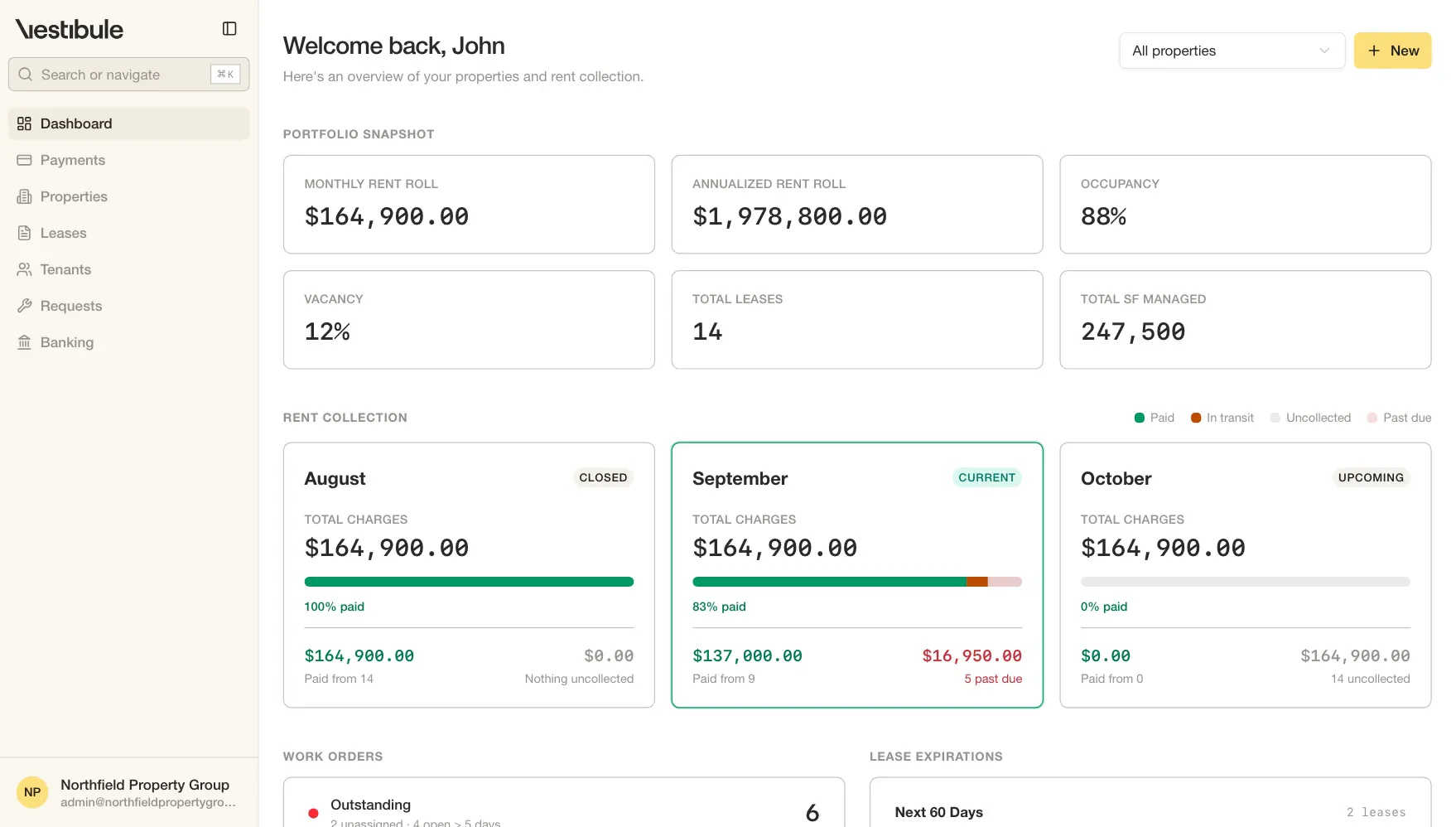
Ownership wants to see the portfolio: total rent roll, collections, delinquency, upcoming expirations. Lenders and partners want to see one entity at a time. Both are reasonable, and you can serve both by consolidating the reporting, not the records.
A few practices make that work:
- One chart of accounts, used everywhere. If every entity books rent, recoveries, and expenses to the same account structure, totals add up without a mapping exercise each month.
- One close calendar. Close every entity on the same schedule, so the portfolio report isn’t mixing a closed month for one building with an open month for another.
- Property and entity on every record. Every lease, charge, payment, and invoice should carry both the property and the owning entity, so any report can be cut either way.
- Totals that drill down. A portfolio number should always break back down to the entity and property figures behind it. If someone can’t trace a total to its parts, it will be questioned.
- Ownership shares kept outside the books. Where partners own different stakes in different entities, apply those percentages in reporting, not by splitting transactions.
The accounting system stays the system of record for each entity. The portfolio view sits on top of it and reads from it, so nobody rebuilds the books in a spreadsheet to answer a question from ownership.
A checklist for adding a new property LLC
The weeks after an acquisition, before the new entity’s setup is finished, are an easy time for money to land in the wrong place. Work through these before the first rent payment is due.
- Review the loan documents and operating agreement with counsel, and note any separateness, reporting, or bank account requirements.
- Open the entity’s operating account, plus a separate security deposit account where the leases or local rules require one.
- Set up the entity’s books on the portfolio’s standard chart of accounts and close calendar.
- Confirm which entity each lease names as landlord, and send every tenant a notice with the new landlord name, remittance details, and accurate W-9 information for the landlord.
- Transfer security deposits into the new entity’s account and record them on the new books, as the purchase agreement and leases require.
- Re-paper or assign vendor contracts to the new entity, and update billing names and payment accounts.
- Confirm insurance names the right entity and property, and record how any blanket policy will be allocated.
- Add the property and entity to portfolio reporting, and check that the first month’s numbers trace back to the entity’s own records.
Tenant notices deserve extra care. A tenant that keeps paying the seller, or the wrong entity, creates exactly the kind of cleanup this article is about. Follow up on any tenant whose first payment doesn’t arrive at the new account.
The bottom line
A separate LLC for each property is only as useful as the separation behind it. In practice, that means each one has its own bank accounts, books, and tax identity; every collection is properly authorized, attributed to the right entity, recorded, and settled to it, whether tenants pay each landlord LLC directly or through an authorized centralized collection arrangement; shared costs are allocated on a documented basis and settled as the governing agreements allow; and portfolio reporting is built on top of each entity’s records rather than by merging them. Much of the risk sits in ordinary moments: a combined check, a shared invoice, a new building’s first month.
Vestibule gives tenants a branded portal where they can see their charges, statements, and how each payment was applied, which makes it easier for them to pay the right amounts to the right place. Each tenant can have several users, including someone in finance. Vestibule works alongside accounting systems such as Yardi, MRI, and AppFolio, which remain the system of record for each entity’s books.
See how Vestibule organizes a portfolio. Explore the Portfolio page or request a demo.
Related reading
- How to Reconcile Commercial Tenant Payments Without Spreadsheets. What to do when a payment arrives without enough detail to apply it.
- How to Collect Commercial Rent Electronically: ACH, Checks, and Credit Cards. How tenants pay, and what to ask them for.
- The Modern Commercial Landlord: Why Property Management Needs a New Operating System. Why the operating layer should sit alongside the accounting system, not replace it.
Sources
- A Self-Storage Investor’s Guide to CMBS Legal Requirements, Part 1: The Single-Purpose Entity, Shawn Hill and Charlie Marshall, Inside Self-Storage, May 2015. Used for typical single-purpose-entity and separateness requirements in CMBS lending.
- Single Member Limited Liability Companies, Internal Revenue Service, page last reviewed or updated July 27, 2026. Used for the tax ID and W-9 treatment of disregarded single-member LLCs.
- Instructions for Forms 1099-MISC and 1099-NEC (Rev. April 2025), Internal Revenue Service, April 2025. Used for the rent reporting note.