ResourcesTenant Experience, Transparency & Retention
What Commercial Tenants Expect From Building Management
A service-standards playbook for commercial landlords: what office, retail, industrial, and medical tenants expect, and how to deliver it.
Vestibule Editorial
· 14 min read
Ask a commercial tenant what they want from building management and most will say some version of “take care of it, and tell me what’s happening.” That sounds simple. Delivering it consistently across a portfolio takes more than good intentions.
It takes clear standards: who acknowledges a request, how fast, what counts as urgent, when the tenant hears back, and how the team knows a problem is actually fixed. It also takes recognizing that an industrial distributor and a medical practice need different things, and that the CFO and the office manager at the same tenant are judging you on different work.
This article is a practical playbook for those standards. The business case for better service is covered in Does Better Tenant Experience Lead to Higher Commercial Lease Renewals? Here, the focus is the operating practice that delivers it.
What the satisfaction research says tenants weigh most
Grace Hill’s KingsleySurveys program collects ongoing satisfaction feedback from commercial tenants. Its 2025 report reaches a clear conclusion: “Across all property types, management service delivery remains the most predictive driver of overall satisfaction” (Grace Hill, 2025 CRE Emerging Trends Report).
The report also lists the five factors most closely tied to overall satisfaction for each property type:
- Every type: management’s overall performance, problem resolution, and communication lead the list for office, retail, industrial, and medical office.
- Office and medical office: accounting satisfaction makes the top five.
- Retail and industrial: maintenance and engineering satisfaction makes the top five.
- Leasing process: appears in the top five for office, retail, and industrial.
Two cautions apply. These are correlations with satisfaction, not proof that one factor causes another. And the report doesn’t measure response times, so it can’t tell you what a “fast enough” response is. What it does show is where tenants direct their attention: whether problems get solved, whether they hear what’s happening, and, for office and medical tenants, whether the billing is right. Those are operating disciplines, and the rest of this article covers how to build them.
Expectations by property type
The basics are the same everywhere: fix problems, communicate, bill accurately. What changes by property type is what disrupts the tenant’s business, who calls you, and what “urgent” means.
What changes by property type
Five things to settle before you set a service standard, across the four property types most commercial portfolios hold.
Office
What disrupts the business mostTemperature, elevators, access, and building systems during work hours
Who usually contacts youOffice manager, then facilities or finance
What urgent usually meansA system outage affecting a floor or a suite during business hours
Communication they needNotice of planned shutdowns and work in common areas; status updates on open requests
Billing focusAccurate statements, operating expense reconciliations, and backup
Retail
What disrupts the business mostAnything customers see: storefront, parking, lighting, common-area cleanliness, during trading hours
Who usually contacts youStore or general manager on site; corporate real estate or finance for billing
What urgent usually meansAnything that affects opening on time or customer safety
Communication they needNotice of work that affects access, parking, signage, or hours; work scheduled outside trading hours where possible
Billing focusCAM, real estate tax, and other recoveries, often reviewed by a corporate team
Industrial
What disrupts the business mostDock doors, yard access, roof leaks, and power: anything that stops shipping and receiving
Who usually contacts youPlant, warehouse, or operations manager; corporate AP for billing
What urgent usually meansAnything that halts loading, receiving, or production
Communication they needDirect, practical updates with realistic repair times, often by phone, to the person on the floor
Billing focusClear charges and responsibility for repairs under the lease
Medical office
What disrupts the business mostTemperature, water, power, and access in clinical space, plus patient-facing areas
Who usually contacts youPractice administrator or office manager
What urgent usually meansAnything that affects patient care, scheduling, or regulated equipment
Communication they needAdvance notice of anything that could interrupt appointments; clear points of contact after hours
Billing focusAccurate statements and recoveries; after-hours service charges explained
This matrix is a starting point, not a rulebook. A creative agency in a converted industrial building may behave like an office tenant, and a flagship retail tenant may have its own facilities team. Ask each tenant who their contacts are and what disrupts their business most, and record the answer.
Different people at the same tenant want different things
A tenant isn’t one customer. It’s several people, each judging the building on different work. A management team that serves only the loudest contact will disappoint the others without realizing it.
| Contact | What they judge you on | What good service looks like to them |
|---|---|---|
| CFO or finance team | Accuracy and predictability | Statements that match the lease, charges with backup, clear explanations of reconciliations, and an answer to billing questions without being passed around |
| Office or store manager | Day-to-day responsiveness | Requests acknowledged quickly, status they can check without calling, advance notice of anything that affects their space, and one place to go |
| Facilities contact | Technical competence | Specifics about the problem and the fix, vendor schedules, root causes for repeat issues, and planned shutdowns coordinated in advance |
| Executive leadership | The relationship and the big decisions | Someone senior who knows their business, a proactive check-in at least once a year, and a clear escalation path when something goes wrong |
Three practices help serve all four:
- Map the contacts for every tenant. Record who handles requests, who receives statements, who has authority to approve work, and who the senior contact is. Update the list when people change, because they will.
- Route by topic, not by whoever called. A billing question raised by the store manager still needs to reach finance, with a copy back to the store manager so they know it’s handled.
- Keep a single history. When the CFO calls about a chargeback for a repair, the person answering should be able to see the original request, the work done, and why it was billed.
Acknowledge, prioritize, resolve, close out
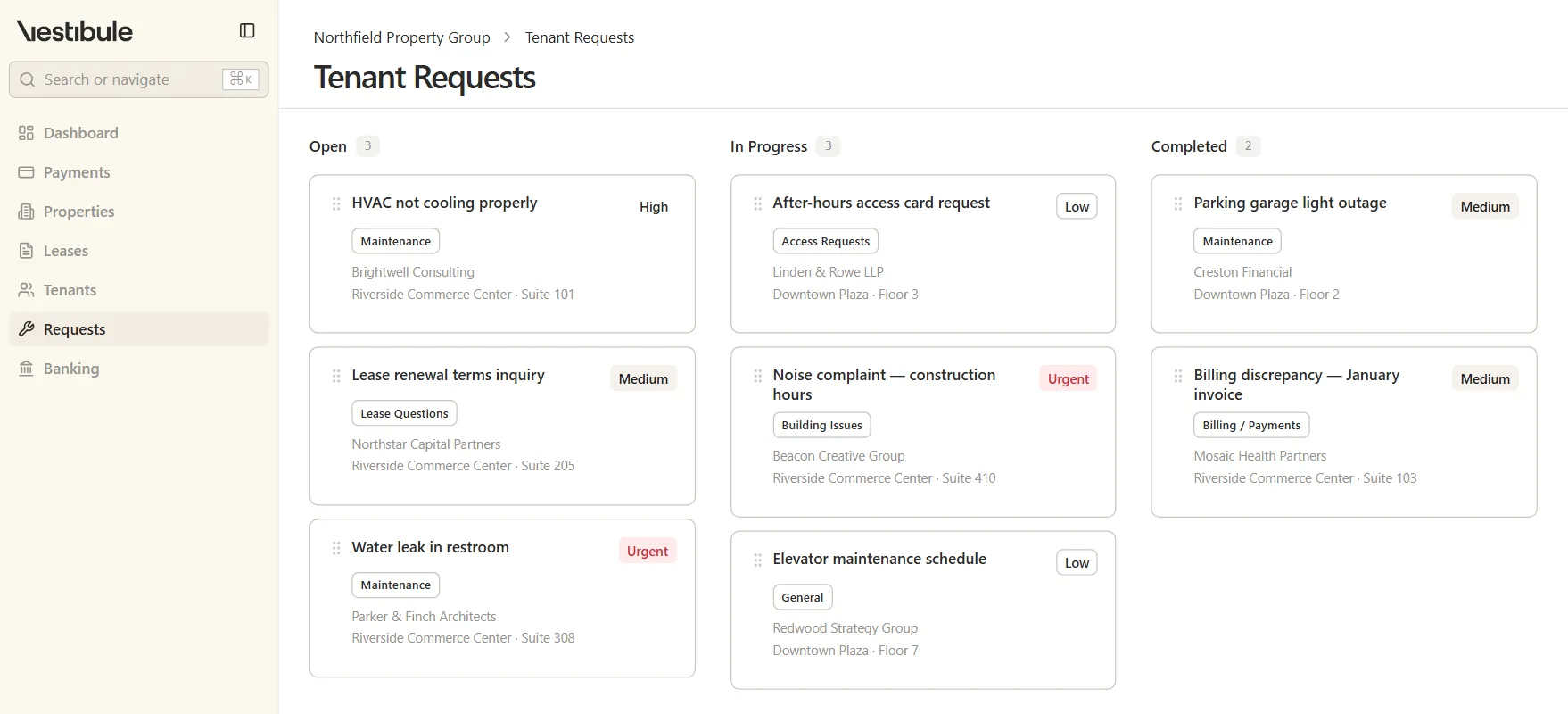
Tenants see a request move from submitted to closed. Behind each stage is a set of internal decisions that determines whether the experience is good. For the tenant-facing view of a well-run request, see Why Every Commercial Landlord Should Offer a Branded Tenant Portal. This section covers the standards your team works to.
Acknowledge
The acknowledgment does three things: it confirms the request was received, names who owns it, and tells the tenant when they’ll hear next. An automated “we received your request” covers only the first. Decide who acknowledges each type of request, during and after business hours, and what the acknowledgment must say.
Prioritize
Genuine safety emergencies sit outside the normal request queue. A fire, a gas leak, an injury, flooding near electrical equipment, or a security threat should trigger the building’s emergency procedures right away, including calling emergency services where appropriate. The work order records what happened. It isn’t the response.
Priority should come from defined criteria, not from who’s asking or how loudly. A simple four-level scheme is a practical starting point. Ownership sets the target times for each level, based on the leases, staffing, vendor contracts, and local conditions.
| Priority | Typical situations | What your standard should define |
|---|---|---|
| Emergency | Situations that threaten people or property, such as active water intrusion, loss of power to a suite, or a security breach. Life-safety events follow emergency procedures first | Who is called, at any hour; when someone must be on site; who notifies the tenant’s senior contact |
| Business-disrupting | A failed dock door, no cooling in occupied space, a storefront that won’t lock, a stuck elevator in a low-rise building | Target time to respond and to restore service; how often the tenant gets updates until it’s fixed |
| Routine | A light out, a sticking door, a minor leak under a sink | Target time to complete; whether it can be batched with other work |
| Scheduled | Requested improvements, preventive maintenance, after-hours HVAC, move coordination | Lead time the tenant must give; how the date is confirmed |
Treat the examples as a guide, not a rule. Priority depends on severity and circumstances: a small leak is routine in a storage room and urgent above a server room. Write down how the lease affects each one: who is responsible for the repair, and whether the cost can be billed back. Where you can, tell the tenant before the work starts if they’ll be charged. Emergency work sometimes can’t wait for that conversation; when it can’t, explain the charge promptly afterward. Either way, financial responsibility follows the lease.
Resolve
Resolving a request means more than dispatching someone. The owner of the request tracks it until the problem is fixed, sends updates on the promised schedule even when there’s no news, and resets expectations as soon as a part or vendor delay is known. A tenant can live with a repair that takes a week. What they remember is not hearing anything for four days.
Close out
Close a request when the tenant confirms the problem is fixed, not when the technician leaves. If the tenant doesn’t respond, the team can close it administratively after documented attempts to confirm. Record it as closed without confirmation, not as tenant agreement. Close-out should record what was wrong, what was done, what it cost, and whether it was billed to the tenant. Make it easy for the tenant to reopen a request if the problem comes back. Then look for patterns: the same equipment, the same suite, or the same kind of request repeating is a capital or maintenance question, not a service question.
Four common problems, handled well
Illustrative examples. The tenants and situations are hypothetical.
Office: two suites, one thermostat
An accounting firm in Suite 600 says it’s too cold. The architecture firm next door in Suite 610 says it’s too warm. Both suites are on the same HVAC zone.
What usually happens. Each complaint is treated as its own request. A technician lowers the setpoint for one tenant, which produces a complaint from the other, and the tickets bounce back and forth for weeks.
Good handling. The engineer links the requests and reviews the zone, including setpoints, airflow, and diffuser placement. The manager tells both tenants plainly what the constraint is and what will be tried. If balancing doesn’t resolve it, splitting the zone becomes a capital decision for ownership, with the request history as the supporting record.
Medical office: badges fail on a Saturday
Staff at a dental practice arrive for Saturday appointments and their access badges don’t work. Patients are waiting outside.
What usually happens. The after-hours number reaches an answering service that takes a message. Someone calls back hours later.
Good handling. The after-hours path reaches a person who can act, such as building security or an on-call manager. Access is restored on site. The team then aims to find the cause the same day, for example a credential update that deactivated the wrong group, and tells the practice when it will have an answer if it can’t. The practice administrator gets a short written explanation, and the team checks whether other tenants were affected.
Retail: a billing error that reaches the wrong person
A store manager forwards a statement showing real estate tax charged twice for the same month after a lease amendment changed the tenant’s share. The store manager can’t approve or dispute charges. Corporate finance has put the payment on hold.
What usually happens. The property manager replies to the store manager, who doesn’t own the problem, and the corporate team hears nothing.
Good handling. The question is routed to the property accountant and the tenant’s finance contact, with the store manager copied so they know it’s being handled. The team confirms the error, issues a corrected statement with a short explanation, and checks whether the same setup error affected other tenants after that amendment. For the ledger side, see How to Reconcile Commercial Tenant Payments Without Spreadsheets.
Industrial: a dock door that keeps failing
A distributor’s main dock door fails for the third time in two months. The warehouse manager needs the door working. The tenant’s AP team, meanwhile, is questioning repair chargebacks it didn’t expect.
What usually happens. Each failure is fixed as a one-off, and each repair is billed without explanation.
Good handling. One standard covers both people. The failure is treated as business-disrupting: the team confirms a workaround, such as an adjacent door, and gets a vendor on site. After a repeat failure, the team looks for the cause rather than repairing it again. Before anything is billed, the manager checks the lease to see who is responsible. Damage from equipment and normal wear are often treated differently. AP is told about any chargeback, with the backup, before the invoice arrives.
Writing service standards and measuring them
Many management teams run on informal standards: the good property manager calls back the same day. Written standards make that consistent across buildings and staff changes, and give ownership something to measure.
What a service standard should cover
Keep it to a page or two, and set the numbers yourself, based on your leases, staffing, and vendor agreements:
- Priority definitions with examples, as in the table above.
- Target times by priority: to acknowledge, to respond on site, and to resolve or provide a plan.
- Update cadence for open requests, by priority.
- Close-out rule: tenant confirmation is preferred. Administrative closure follows a set number of documented attempts to confirm, and is recorded as unconfirmed.
- After-hours coverage: who answers, who has authority to act, and how tenants reach them.
- Billing inquiries: who responds, and the target time for an answer or a corrected statement.
- Notice of planned work: how far ahead tenants are told about shutdowns, common-area work, and anything affecting access.
- Relationship contact: a check-in with each tenant’s senior contact at least once a year, more often for larger tenants or before renewals.
How to measure it
The measures that matter are the ones a tenant would notice. Review them monthly with property managers and quarterly with ownership:
- Acknowledged within target: the share of requests acknowledged within the standard, by priority.
- Resolved within target: the same for resolution, with the exceptions explained.
- Reopen rate: requests reopened after close-out, a direct sign that “fixed” didn’t mean fixed.
- Repeat requests: the same equipment, suite, or issue appearing again within a set period.
- Open-request aging: how many requests are open past target, and for how long.
- Billing inquiries: the number received and the time to resolve them, as an early sign of statement or setup errors.
- Tenant feedback: a short survey after close-out, and a broader survey on a regular cycle.
Numbers alone won’t tell the full story. Read a sample of closed requests each month, including the tenant’s own words, and look for the pattern behind any number that moves.
The bottom line
Commercial tenants judge building management on whether problems get solved, whether they hear what’s happening, and whether the billing is right. What that looks like differs by property type and by the person at the tenant asking. Written standards, clear ownership of every request, honest updates, close-out the tenant agrees with, and a handful of measures reviewed every month are what turn good intentions into consistent service.
Vestibule gives commercial landlords a branded tenant portal where tenants submit and track service requests, see their status, and reopen a request if the problem comes back. Building notices, statements, and documents live in the same place. Each tenant can have several users with appropriate access, so the right people at each tenant see the right information.
See how Vestibule handles tenant requests and communication. Explore the Tenant Portal page or request a demo.
Related reading
- Does Better Tenant Experience Lead to Higher Commercial Lease Renewals? The business case for the practices in this article.
- Why Every Commercial Landlord Should Offer a Branded Tenant Portal. What tenants should be able to see and do on their own.
- How to Reconcile Commercial Tenant Payments Without Spreadsheets. How to handle the billing side of tenant questions.
- The Modern Commercial Landlord: Why Property Management Needs a New Operating System. Why service, billing, and lease data work better connected.
Sources
- 2025 CRE Emerging Trends Report (Kingsley Index), “Shaping Tenant Sentiment in 2026”, Grace Hill (KingsleySurveys), 2025. No publication month shown. Used for the most predictive driver of satisfaction and the top five correlated factors by property type.